50.5k
50.5k

Speed is a feature that motivates much of ClickHouse product design and engineering. One can plainly see this attention to performance in our development of benchmarks, such as ClickBench and PostgresBench, some of which have become industry standards. Unsurprisingly this ethos reaches the deepest crevices of our products, down to SQL functions and operators.
In that spirit, we've introduced pg_re2, a Postgres extension providing fast RE2-powered regular expressions in Postgres. Install it from PGXN or GitHub; ClickHouse Managed Postgres already has it.
You can install it like so:
CREATE EXTENSION re2;Then you're ready to go!
SELECT 'HouseQuake' @~ 'Quake\b';?column?
----------
t
(1 row)Hit the docs for the full list of features.
Of course, Postgres itself provides a wealth of regular expression operators and functions. Why provide an alternate? Two reasons: speed, of course, but also compatibility.
The need for speed
Ultimately, the Postgres and RE2 regular expression engines rest on fundamentally different search algorithms. Postgres POSIX regular expressions depend on backtracking, returning the longest match, while RE2 relies on finite automata. In his article announcing RE2 back in 2010, Russ Cox summarized:
RE2 demonstrates that it is possible to use automata theory to implement almost all the features of a modern backtracking regular expression library like PCRE. Because it is rooted in the theoretical foundation of automata, RE2 provides stronger guarantees on execution time than and enables high-level analyses that would be difficult or impossible with ad hoc implementations. Finally, RE2 is open source. Have fun!
Such findings underpin the choice to power ClickHouse string search, string replacement, string extraction, and string splitting with RE2. We wanted to provide similar benefit to our Postgres users.
Benchmark
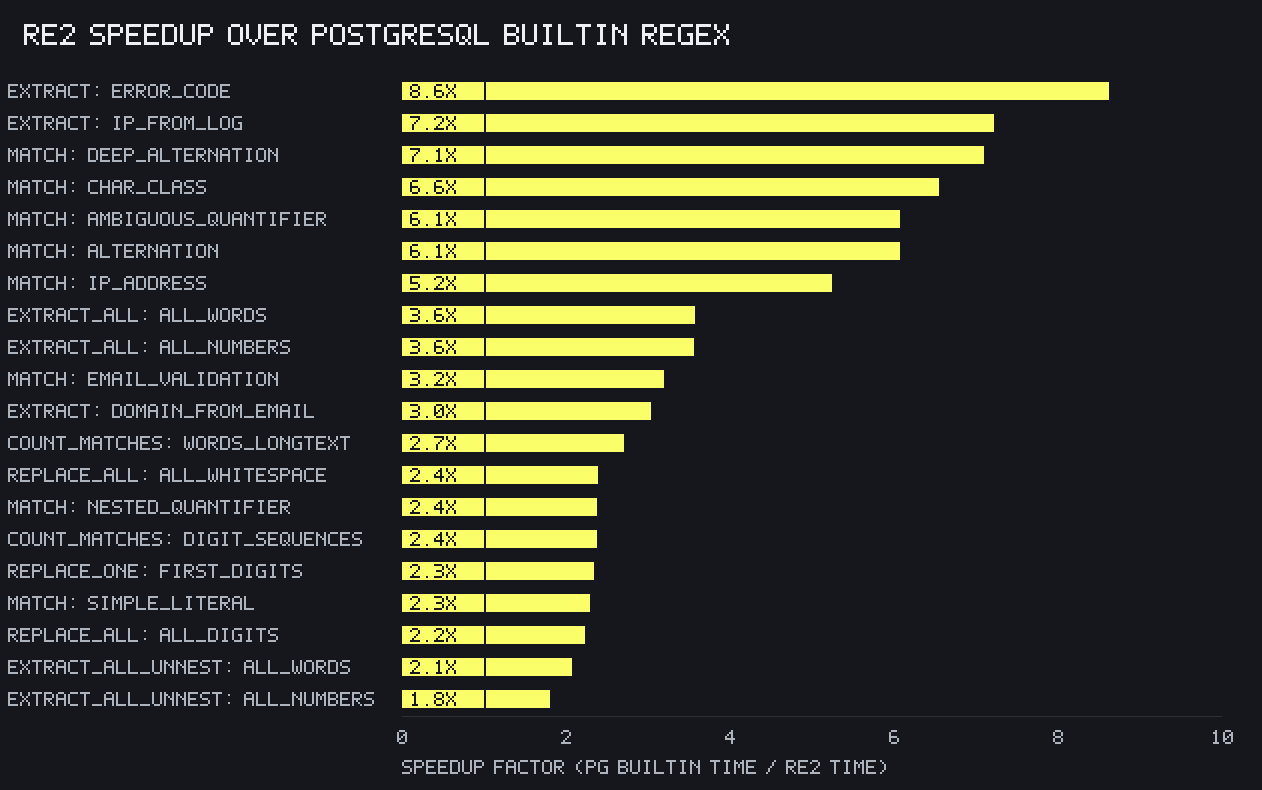
Naturally, the pg_re2 project includes a benchmark that compares the raw performance of its RE2-backed regex functions to the Postgres native functions. This graph summarizes the horizontal speedup factors on an AWS m6g.2xlarge instance with PostgreSQL 18:
Findings:
-
RE2 wins every test, with performance 1.8x to 8.6x that of Postgres.
-
The largest gains come from extract_all (7.2-8.6x) which returns arrays directly, in contrast to the admittedly unfair comparison to the Postgres
regexp_matches(..., 'g')function's set-returning overhead.
Indexing
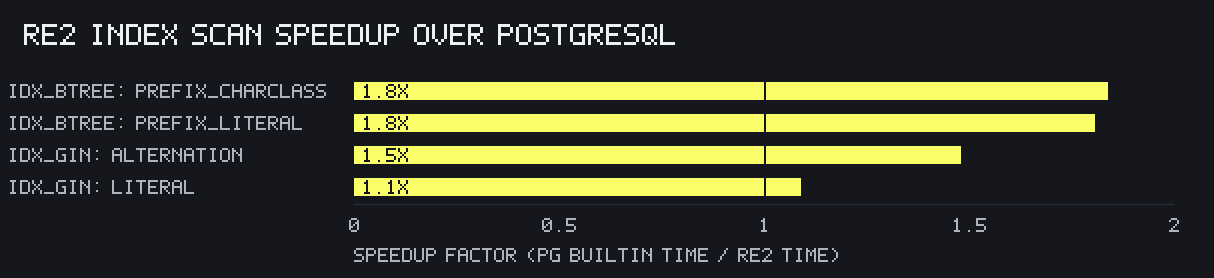
pg_re2 v0.4.0 adds a matching operator, @~, to complement the Postgres ~
operator, along with btree and GIN index support to reduce the need for
table scans when evaluating RE2 regular expressions. A second benchmark
compares RE2 to Postgres regular expression index performance on the same
server:
Findings:
-
RE2 again wins every test, with 1.1x to 1.8x acceleration over the equivalent Postgres operations.
-
Prefix matching against a btree index provides similar overall speedup to a table scan because each applies raw execution speed to index entries.
-
The
gin_re2_opsGIN opclass benefits from collecting the byte-equivalent trigrams that RE2 requires, including across punctuation, such that patterns likeerror_code=42[0-9]use the index where Postgres regular expressions against thepg_trgmopclass fall back to a full table scan. -
On plain-word patterns the RE2
gin_re2_opsand Postgrespg_trgmopclasses extract similar keys andpg_trgm's cheaper consistent check can win (seeerror_code=123above).
Overall, the performance improvements identified by Russ Cox hold true for regular expressions in Postgres, too.
We are so compatible
The second driver for creating pg_re2 was compatibility with ClickHouse regular expression functions. Turns out that RE2 differs from Postgres POSIX expressions not only in speed but also syntax. These variations matter because pg_clickhouse v0.2.0 added pushdown for several PostgreSQL operators and functions. It works well for simple regexen:
SELECT id, by FROM log.entries WHERE by ~ 'Click' ORDER BY id;id | by
----+------------
1 | ClickHouse
5 | MouseClick
(2 rows)If you'd like to follow along, the following examples use this ClickHouse table:
CREATE TABLE entries ( id UInt32 NOT NULL, by String NOT NULL ) ENGINE = MergeTree ORDER BY (id); INSERT INTO entries VALUES ( 1, 'ClickHouse' ), ( 2, 'HouseQuake' ), ( 3, 'HouseQuake' ), ( 4, 'QuakerOats' ), ( 5, 'MouseClick' );And this pg_clickhouse foreign table configuration in Postgres:
CREATE EXTENSION pg_clickhouse; CREATE EXTENSION re2; CREATE SERVER ch FOREIGN DATA WRAPPER clickhouse_fdw OPTIONS(driver 'binary'); CREATE USER MAPPING FOR CURRENT_USER SERVER ch; CREATE SCHEMA log; IMPORT FOREIGN SCHEMA "default" FROM SERVER ch INTO log;
It's also useful for simple anchored expressions like ^ and $:
SELECT id, by FROM log.entries WHERE by ~ '^House' ORDER BY id;id | by
----+------------
2 | HouseQuake
3 | HouseQuake
(2 rows)But sometimes pg_clickhouse returns unexpected results:
SELECT id, by ~ 'Quake\b' FROM log.entries WHERE by ~ 'Quake\b';id | ?column?
----+----------
2 | f
3 | f
(2 rows)Here by ~ 'Quake\b' in the WHERE clause, which pushes down to ClickHouse,
returns true for two rows, but the same expression in the select list, which
executes in Postgres, surprisingly returns false! How could that be?
Postgres POSIX vs. ClickHouse RE2
This perplexing outcome derives from a difference between the two engines. In
ClickHouse, \b represents a word boundary, while in Postgres it represents a
backspace character. Thus the WHERE expression pushed down to ClickHouse
returns true, while the SELECT expression that executes in Postgres does
not.
A panoply of such variations exists between these two engines. Quite a few of the backslash features work differently or don't exist in one or the other:
| Feature | Postgres | ClickHouse |
|---|---|---|
\b | backspace | word boundary |
\B | Backslash | not word boundary |
\cx | low-order 5 bits same as x | 🚫 |
\C | 🚫 | match a single byte |
\uwxyz | character with hex value 0xwxyz | 🚫 |
\Ustuvwxyz | character with hex value 0xstuvwxyz | 🚫 |
\m | beginning of word | 🚫 |
\M | end of word | 🚫 |
\y | word boundary | 🚫 |
\Y | not word boundary | 🚫 |
\Z | end of string | 🚫 |
\1, \2 … | backreference to nth capture | 🚫 |
\f | form feed | form feed |
\Q...\E | 🚫 | literal text |
\p{Foo} | 🚫 | Unicode character class Foo |
\pF | 🚫 | Unicode character class F |
[:ascii:] | ASCII characters | ASCII characters |
Both also support flags passed via (?xyz) or via an additional argument to
Postgres functions. But the flags deviate substantially:
| Flag | Postgres | ClickHouse |
|---|---|---|
b | rest of regex is a basic regex | 🚫 |
c | case-sensitive matching | 🚫 |
e | rest of regex is an extended regex | 🚫 |
g | return all matches | 🚫 |
i | case-insensitive matching | case-insensitive |
m | historical synonym for n | ^ and $ match begin/end line |
n | newline-sensitive matching | 🚫 (use m) |
p | partial newline-sensitive matching | 🚫 |
q | rest of regex is literal text | 🚫 |
s | non-newline matching (default) | let . match \n (default) |
t | tight syntax (e.g., not expanded) | 🚫 |
w | inverse partial newline-sensitive | 🚫 |
x | expanded syntax | 🚫 |
U | 🚫 | ungreedy |
The wording for flags supported by both engines differs, but seems to amount to the equivalent behaviors. For example, PostgreSQL's term "non-newline matching" means the pattern is insensitive to and therefore does match newlines. These documentation differences complicate validation of the behaviors difficult without testing!
But wait, there's more! A few examples:
- ClickHouse doesn't support arbitrary lookahead or lookbehind assertions
(
(?=re),(?!re),(?<=re), and(?<!re)) - ClickHouse doesn't support backreferences (
\1,\2, etc.), such as one might use to pair quotation marks:(["'])(.*?)\1; but both support them in replacement expressions - Collations and locales determine the non-ASCII characters included in Postgres character classes, while ClickHouse RE2 character classes contain only ASCII characters.
Consequences
These variations constitute a fraction of the differences between the two regular expression engines. Clearly one must be wary of them when querying pg_clickhouse tables. Test your regular expressions thoroughly, especially when using flags, character classes, and backslash features.
To simplify the problem (or maybe create two problems), we've added pg_re2 function pushdown to pg_clickhouse v0.3.0. Using pg_re2 functions for columns in pg_clickhouse tables provides multiple benefits over pushing down Postgres regex functions:
- No need to determine whether pushdown is happening or not, as the behavior matches on both databases
- RE2 delivers asymptotically better performance; we might have mentioned that fact
- For ClickHouse use cases, one need only grapple with a single regex syntax
The benefits become clear when revisiting the unanticipated results that started this section:
SELECT id, by ~ 'Quake\b' FROM log.entries WHERE by ~ 'Quake\b';id | ?column?
----+----------
2 | f
3 | f
(2 rows)Note again that ~ returns true when pushed down to ClickHouse, but false
when executed in Postgres. Replacing the Postgres ~ operator with the re2
extension's re2match() function still pushes down to the ClickHouse match
function:
SELECT id, re2match(by, 'Quake\b')
FROM log.entries where re2match(by, 'Quake\b');id | re2match
----+----------
2 | t
3 | t
(2 rows)But because the re2 extension uses the same RE2 library as ClickHouse, the
query now returns consistent results: re2match() returns true when executing
in Postgres and when pushed down to ClickHouse.
Let's go!
The re2 extension derives from our goal to synthesize Postgres & ClickHouse as cooperating parts of a single, high performance data platform. It thus duplicates the full suite of ClickHouse regex functions described in the string search, string replacement, string extraction, and string splitting documentation, and its test suite draws from ClickHouse's existing regex tests.
We therefore wholeheartedly recommend using pg_re2 where possible for faster regex execution on Postgres. Even more so for analytical queries to ensure performance and pushdown remain consistent once the data migrates to ClickHouse.
Try Postgres managed by ClickHouse
ClickHouse + Postgres has become the unified data stack for applications that scale. With Managed Postgres now available in ClickHouse Cloud, this stack is a day-1 decision.
Sign up