 50.6k
50.6k
TL;DR
- Start with hard gates such as required extensions, regions, private networking, HA and PITR behavior, replication access, privileges, and export requirements. Eliminate any provider that cannot meet them.
- Shortlist Amazon RDS for PostgreSQL or Aurora when AWS-native identity, networking, procurement, required regions, or an established AWS operating model is decisive. Apply the same logic to Cloud SQL or AlloyDB for GCP and Azure Database for PostgreSQL Flexible Server for Azure.
- Include Neon when branching, preview databases, or idle suspension are core requirements. Include Crunchy Bridge when a required PostgreSQL extension or setting is a hard gate, and Aiven when managing PostgreSQL alongside other open-source data services through one provider matters.
- Evaluate ClickHouse Managed Postgres for performance-critical transactional workloads and native integration with ClickHouse for real-time analytics, using the standby topology that matches your durability requirements. If analytical workloads are materially affecting transactional performance, evaluate whether Postgres should continue scaling alone or whether analytics should move to a dedicated OLAP system.
- Validate finalists with your actual schema, workload, failover process, restore workflow, connection behavior, and data movement requirements before comparing the final production cost.
PostgreSQL is often the easy choice for an application database. The harder decision is how to run it in production.
For many SaaS applications, Postgres sits directly on the path between a user action and the result they see. When the database slows down, the application often slows down with it. When it becomes unavailable, users may be unable to read or update the state the application is responsible for preserving. That makes database performance, availability, and recovery part of the product experience, not just infrastructure concerns.
A managed Postgres provider therefore becomes part of the application's stateful architecture. Storage design affects I/O behavior, while replication and failover choices shape what happens during failures. Connection handling, backup workflows, recovery behavior, and operational limits determine how the system behaves as load and data volume grow.
These differences become more important when the original production setup starts to show strain. Write throughput may increase, connection pools may saturate, recovery requirements may tighten, or analytical queries may begin competing with transactional traffic. At that point, choosing between managed Postgres providers is less about comparing feature lists and more about choosing the operating model and production topology that fit the workload.
This guide provides a framework for defining those requirements, eliminating providers that fail critical gates, shortlisting the right architectures, and validating the finalists with a production-representative POC.
Managed Postgres providers to consider in 2026
Use this shortlist to identify the operating models worth evaluating. It is not a ranking. Apply your hard gates before deciding which providers belong in the final POC.
| Provider | Operating model | Consider when | Validate before choosing |
|---|---|---|---|
| ClickHouse Managed Postgres | Specialist managed Postgres | Performance matters, or you expect a future path from transactional Postgres to separately provisioned ClickHouse analytics | Required region, extension support, standby topology, recovery behavior, networking, and production cost |
| Amazon RDS for PostgreSQL | Hyperscaler managed Postgres | AWS identity, networking, procurement, required regions, or an established RDS operating model is decisive | Multi-AZ topology, storage configuration, connection handling, extensions, recovery, and full production cost |
| Amazon Aurora PostgreSQL-Compatible Edition | PostgreSQL-compatible hyperscaler database | AWS alignment matters and Aurora's storage, failover, read-scaling, or Serverless v2 model fits the workload | PostgreSQL compatibility requirements, storage and I/O model, failover behavior, replication access, and Serverless configuration |
| Google Cloud SQL for PostgreSQL | Hyperscaler managed Postgres | GCP identity, networking, procurement, regions, or an established Cloud SQL operating model is decisive | HA configuration, storage, pooling, extensions, replication, recovery, and production cost |
| Google AlloyDB for PostgreSQL | PostgreSQL-compatible GCP service | GCP alignment matters and AlloyDB-specific read scaling, storage, or analytical capabilities fit the workload | Compatibility, extensions, logical replication, HA, networking, read pools, and cost |
| Azure Database for PostgreSQL Flexible Server | Hyperscaler managed Postgres | Azure identity, networking, regions, procurement, or an established Azure operating model is decisive | HA configuration, storage, pooling, recovery, extensions, private networking, and operational controls |
| Neon | Serverless / developer-workflow Postgres | Branching, preview environments, elastic compute, or idle suspension is decisive | Resume behavior, pooling, logical replication, recovery, steady-state workload performance, and production cost |
| Crunchy Bridge | Specialist managed Postgres | A required PostgreSQL extension, setting, or specialist Postgres operating requirement is decisive | Exact extension and version support, HA, networking, recovery, replication, and migration path |
| Aiven for PostgreSQL | Multi-cloud managed data platform | PostgreSQL alongside other managed open-source data services from one vendor is an important operating requirement | Cloud and region availability, HA plan, networking, support, recovery, and combined service cost |
If you have not yet decided whether to transfer database operations to a managed service, start with self-hosted vs. managed PostgreSQL. If your current baseline is AWS RDS and the decision is specifically whether to leave it, see the AWS RDS alternatives guide.
How to choose a managed Postgres provider: define requirements and hard gates
Define your core Postgres workload and success metrics
A write-heavy OLTP system, a read-heavy application, a connection-heavy serverless backend, and a mixed operational reporting database stress different architectural boundaries.
Quantify success metrics before beginning vendor conversations. Document expected transactions per second (TPS), p95 and p99 latency targets, peak concurrency, storage growth rate, backup retention needs, and acceptable maintenance windows.
Detail the connection profile, separating persistent application servers from short-lived serverless functions, background workers, business intelligence tools, and change data capture (CDC) pipelines.
For a multitenant application, document how tenant data is isolated and how that design affects connection density, provisioning, recovery, and analytical workloads. See the deeper comparison of managed Postgres providers for multitenant SaaS if tenancy architecture is a major selection constraint.
Define production recovery targets by setting the maximum acceptable Recovery Time Objective (RTO) and Recovery Point Objective (RPO) for primary-region infrastructure failure, logical corruption, and accidental deletion.
Separate hard gates from scored evaluation criteria
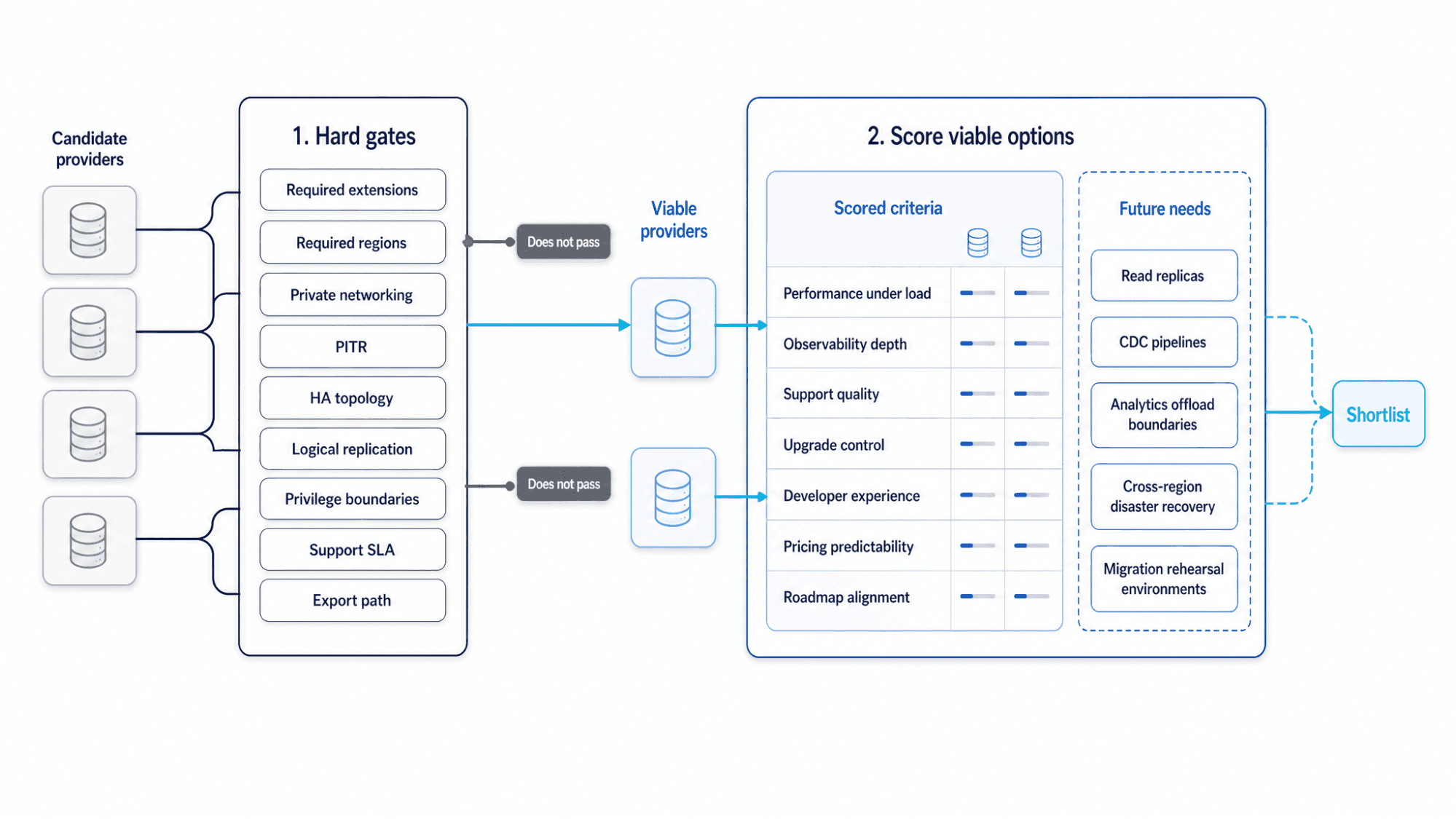
Divide your criteria to prevent nice-to-have features from overriding critical production requirements.
- Hard gates: Required PostgreSQL extensions such as PostGIS, pgvector, or pg_stat_statements, required cloud regions, data residency, private networking, point-in-time recovery (PITR), high availability (HA) topology, logical replication access, privilege boundaries, support SLA requirements, and a clear export path.
- Scored criteria: Performance under load, observability depth, support quality, upgrade control, developer experience, pricing predictability, and roadmap alignment.
- Future needs: Read replicas, CDC pipelines, analytics offload boundaries, branching, cross-region disaster recovery, major-version upgrade cadence, and migration rehearsal environments.
Decide whether you require PostgreSQL or PostgreSQL compatibility
Determine whether the workload requires PostgreSQL itself or whether a PostgreSQL-compatible service is acceptable.
A service can support PostgreSQL drivers and SQL while using a different storage architecture or changing replication behavior, supported extensions, WAL access, privileges, operational settings, or other database internals.
Treat this as a hard gate when the application depends on specific extensions, logical replication behavior, PostgreSQL tooling, operational settings, or engine-level capabilities. Verify each requirement against the exact service and version rather than assuming protocol compatibility means identical PostgreSQL behavior.
Align stakeholders before shortlisting providers
Involve application owners, database and platform teams, security, finance, compliance, and end users of internal tooling early. Assign decision authority and veto power before building the shortlist.
How managed Postgres providers differ by operating model
Use provider archetypes to understand why apparently similar managed PostgreSQL services can create different production architectures. Treat OLTP-to-OLAP as a workload pattern rather than a distinct provider category.
| Provider archetype | Representative examples | Consider when | Hard gate | Verify in POC |
|---|---|---|---|---|
| Hyperscaler managed or PostgreSQL-compatible services | AWS RDS for PostgreSQL, Amazon Aurora PostgreSQL-Compatible Edition, Google Cloud SQL for PostgreSQL, AlloyDB for PostgreSQL, and Azure Database for PostgreSQL Flexible Server | Native cloud identity, networking, procurement, required regions, or an established cloud operating model is decisive | The evaluated service fails a required region, extension, private-networking, recovery, version, or portability requirement | HA topology, failover behavior, PITR restore process, I/O limits, read-replica behavior, network costs, support tier, and cross-region DR options |
| Serverless / developer-workflow Postgres | Neon | Branching, preview environments, or idle suspension is decisive and the workload tolerates the tested resume behavior | The evaluated plan fails a required region, private-networking configuration, recovery objective, or workload-specific latency target | Scale-to-zero configuration and resume latency, autoscaling floor and ceiling, connection limits, pooling mode, plan-specific SLA, logical replication, backup/PITR limits, and production cost at expected load |
| Specialist managed Postgres | Crunchy Bridge, Aiven for PostgreSQL, and ClickHouse Managed Postgres | A required extension or setting, multi-service vendor consolidation, or a performance-critical OLTP workload with an explicitly tested durability topology is decisive | The evaluated provider fails a required extension, operating-model, networking, recovery, support, or export-path gate | Extension support, HA and PITR semantics, upgrade control, logical replication, export path, monitoring depth, support escalation, and analytics offload path |
| Bundled app-platform databases | App-hosting platforms that include managed or semi-managed Postgres alongside application hosting | Deployment simplicity and application-platform integration are decisive for the evaluated workload | The evaluated plan fails a required HA, PITR, networking, operational-control, or export-path gate | Backup ownership, restore workflow, connection pooling, resource isolation, export options, monitoring, and operational responsibility boundaries |
For startup workloads where bundled platforms and developer-oriented Postgres services are part of the shortlist, see the comparison of Postgres hosting providers for startups.
ClickHouse Managed Postgres
Choose ClickHouse Managed Postgres for performance-critical transactional workloads when a POC confirms that the selected zero-standby, one-asynchronous-standby, or two-synchronous-standby configuration meets your durability and recovery requirements.
It uses local NVMe storage physically colocated with compute and supports starting with Postgres alone, then adding a separately provisioned ClickHouse service when analytics warrants it. ClickHouse documents zero-, one-, and two-standby configurations with materially different durability behavior. HA standbys are separate from read replicas.
The service includes PgBouncer for short-lived connections, and point-in-time recovery creates a new instance while leaving the original unchanged.
When analytics offload is in scope, two replication paths connect to a separately provisioned ClickHouse service: ClickPipes for managed batch replication of selected tables, and WalShadow for sub-second synchronization via direct WAL streaming. Both produce an eventually consistent analytical copy, and CDC still uses source Postgres resources for logical decoding, WAL retention, snapshots, and network traffic.
Treat local NVMe throughput and latency as vendor-stated performance claims, and test them under the selected standby topology.
How to compare managed Postgres providers: 7 evaluation criteria
Criterion 1: High availability, failover, backups, and PITR
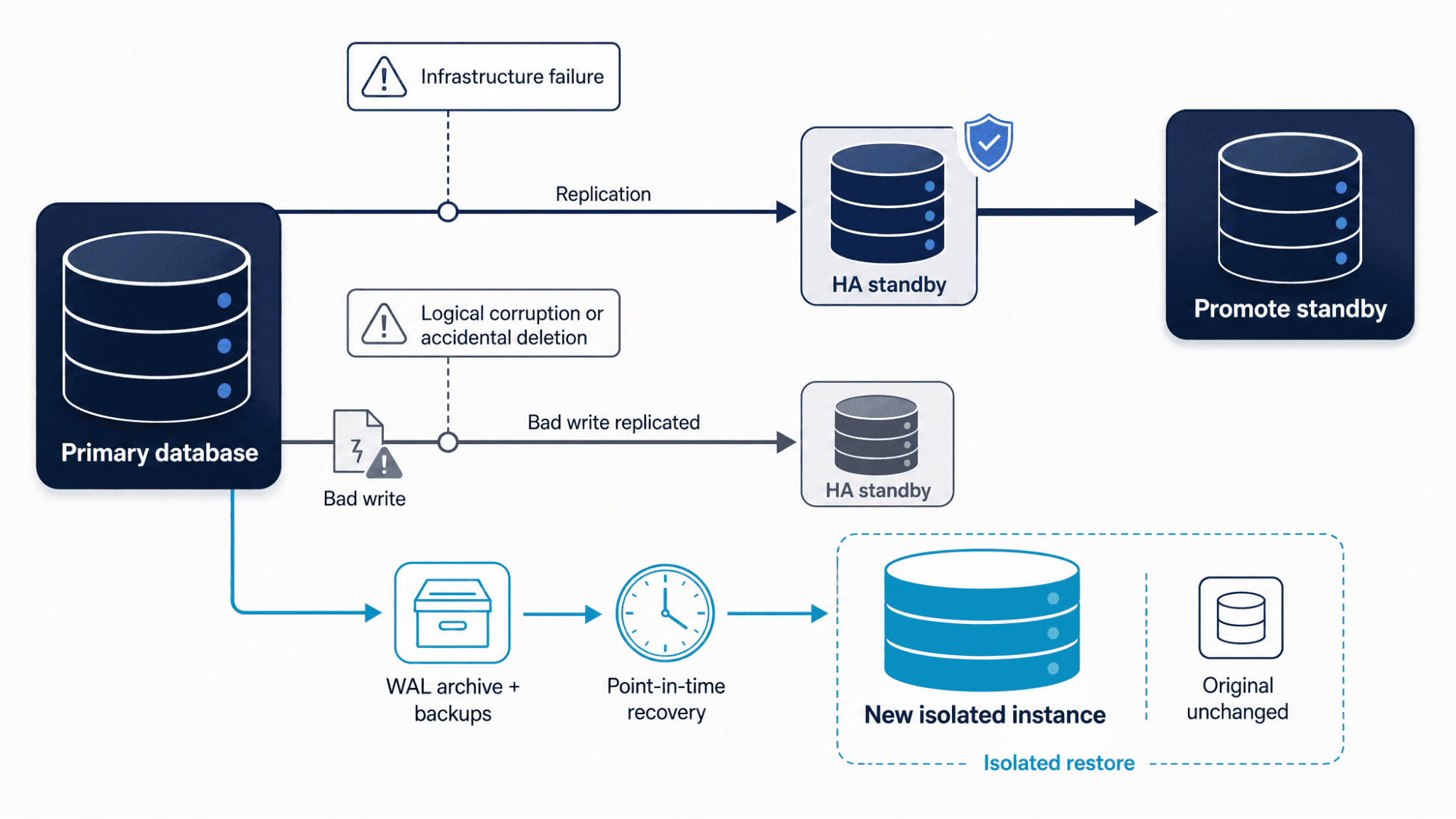
Separate infrastructure availability from disaster recovery and logical recovery. High availability helps an application survive an instance or zone failure. Point-in-time recovery helps the business recover from logical corruption, a bad schema migration, or accidental data deletion.
Evaluate replication semantics. Synchronous replication waits for the configured standby acknowledgment before allowing commit to return, strengthening durability while exposing commits to standby and network delay. Asynchronous replication lets commit return without waiting for standby acknowledgment, so an ungraceful primary failure can lose transactions the standby has not yet received.
Confirm standby promotion behavior, how connections are handled during failover, and whether standbys can serve read traffic.
Confirm backup frequency, WAL archiving cadence, PITR retention windows, restore targets, and whether a restore operation safely creates a new isolated instance without destroying the original.
Key questions to ask
- What is the documented RTO and RPO for the exact production topology we plan to run?
- Is failover synchronous or asynchronous, and what data-loss window exists during ungraceful failure?
- How do we restore to a point in time, and how long does a restore typically take for a database of our size?
Criterion 2: Storage architecture, I/O performance, and connection behavior
Storage architectures typically include local SSD/NVMe, network-attached block storage, or disaggregated cloud storage.
Evaluate sustained IOPS, maximum throughput, WAL-write behavior, and latency during write-heavy workloads. Network-attached block storage offers decoupled scaling and snapshot integration, but introduces a network hop. Local NVMe physically colocates storage and compute to remove that network hop, but its durability and recovery profile also depends on standby topology, WAL archiving, backups, and repair workflows.
Assess how the provider handles PostgreSQL's process-per-connection model. Confirm managed pooling options, PgBouncer compatibility, transaction versus session pooling semantics, and whether direct connections remain available for CDC tools and administrative tasks.
PgBouncer transaction pooling does not preserve arbitrary session state: SET/RESET, LISTEN, SQL PREPARE/DEALLOCATE, preserved temporary tables, and session-level advisory locks are incompatible. Protocol-level prepared statements work only when max_prepared_statements is nonzero, and temporary tables work only with ON COMMIT DROP semantics.
Key questions to ask
- What are the sustained IOPS, throughput, and storage limits for this exact plan?
- What happens when we hit connection limits, storage limits, or I/O saturation?
- Which pooling modes are available, and do they work with our ORM, prepared statements, migrations, and CDC pipeline?
Criterion 3: PostgreSQL compatibility, extensions, privileges, and version lifecycle
A missing spatial, vector, or observability extension fails a hard gate. Confirm that the required extension versions are available and check for managed-service restrictions on how they operate.
Confirm operational privileges. Determine superuser limitations, parameter control, access to database logs, the ability to create logical replication slots, replication user management, and the scope of maintenance operations.
Review version lifecycle policies. Determine the minor-version patching cadence, the major-version upgrade workflow, the availability of test environments or database forks, rollback options, and maintenance window control.
Key questions to ask
- Are our required extensions available on the PostgreSQL versions we need?
- Can we create logical replication slots and manage replication users?
- Can we test major-version upgrades on a fork, branch, replica, or restored environment before production cutover?
Criterion 4: Security, compliance, and network isolation
Evaluate encryption at rest and in transit, private networking capabilities, private endpoints, IP allowlists, public endpoint controls, SSO/SAML integration, database RBAC, multi-factor authentication, audit logs, and customer-managed encryption keys.
Validate required regions, data residency, and compliance reports against vendor documentation and contract terms. A vendor's corporate compliance certification does not automatically mean the specific database service or region is covered.
Confirm whether audit events, access logs, and database logs can export to your Security Information and Event Management (SIEM) system or existing observability stack.
Key questions to ask
- Can production run entirely without a public endpoint?
- Which compliance reports are explicitly available for our selected plan and region?
- Can audit logs, access events, and database logs export to our security tooling?
Criterion 5: Observability, support, and day-two operations
Look for built-in visibility into CPU, memory, cache hit ratio, locks, deadlocks, replication lag, WAL volume, storage saturation, connection pool saturation, long-running transactions, autovacuum behavior, table bloat, and slow queries.
Confirm access to pg_stat_statements, slow query logs, query plan visibility, and retention windows for performance history.
Review support tiers, response-time SLAs, escalation paths, the availability of named technical contacts, incident communication quality, and documentation thoroughness.
Key questions to ask
- Can we identify lock contention, slow queries, replication lag, and pool saturation without third-party tooling?
- How long are metrics, logs, and query insights retained by default, and what does extended retention cost?
- What support tier is required for production incident response?
Criterion 6: Workload fit, data movement, and analytics offload
A Postgres-only topology is valid when transactional and reporting workloads both meet latency targets without excessive overprovisioning.
Watch for analytical pressure triggers: persistent CPU and cache contention between inserts and scans, missed p99 latency targets during reporting windows, complex materialized-view maintenance, or a primary database sized mainly to handle intermittent analytical workloads.
If read replicas no longer solve the reporting bottleneck, evaluate a dedicated analytical system and define consistency expectations. For a broader provider comparison focused specifically on this workload, see best managed Postgres for analytics.
Confirm data movement options for analytics, search, caching, event pipelines, and future migration. These include logical replication, CDC tooling, native connectors, and consistent exports via pg_dump.
Treat logical replication and CDC as production dependencies. Paused consumers can cause replication slots to retain WAL on the primary. Without retention limits, slot invalidation, and alerting, retained WAL can exhaust primary storage. If testing ClickPipes, use a direct logical-replication connection rather than the PgBouncer endpoint.
Measure initial snapshot time, steady-state CDC lag, backlog behavior, and destination load. ClickHouse documents a default 60-second synchronization interval for ClickPipes and sub-second replication lag for WalShadow. Treat this interval as a configuration detail rather than an end-to-end freshness SLA.
Key questions to ask
- Which workloads must remain transactional, and which can tolerate analytical freshness lag?
- Can we create logical replication slots and export a consistent backup without support intervention?
- What restrictions, bandwidth limits, or fees affect downstream replication and large exports?
- If we use ClickPipes or WalShadow, are we connecting through a direct logical-replication connection, and what initial snapshot, CDC lag, backlog, and destination-load behavior should we plan for?
Criterion 7: Managed Postgres pricing and total cost of ownership
Model the exact production topology, not the cheapest single-node plan. A primary compute price can omit material costs in a highly available production deployment.
Managed Postgres providers also expose different pricing models. Understand the unit being billed before comparing headline prices.
| Pricing model | Representative services | What usually drives cost | What to verify |
|---|---|---|---|
| Provisioned instance or node | RDS for PostgreSQL, Cloud SQL, Azure Flexible Server, Crunchy Bridge, ClickHouse Managed Postgres | Compute size, storage, HA nodes, replicas, backups, network transfer, and support | Whether standby resources, I/O, backups, private networking, or replicas are priced separately |
| Cluster or distributed architecture | Aurora, AlloyDB | Compute, storage, I/O or request volume, replicas or read pools, backups, and network traffic | How charges change with read scaling, I/O intensity, HA, and cross-zone or cross-region traffic |
| Serverless or consumption-oriented | Neon and serverless configurations from other providers | Active compute, minimum compute, storage, transfer, and workload duration | Cost under sustained load, minimum-capacity rules, idle behavior, and features that prevent suspension |
| Bundled application platform | Application platforms that package PostgreSQL alongside app hosting | Platform tier, database resources, storage, networking, and paid operational features | Which database capabilities require higher platform tiers and whether the database can be operated or migrated independently |
Include primary compute, HA standby nodes, read replicas, storage growth, provisioned IOPS or throughput limits, backup retention, WAL archival, PITR restores, observability retention, log export, private networking, cross-zone or cross-region traffic, support tiers, staging environments, migration rehearsals, and lifecycle costs.
Watch for forced upgrades, extended support surcharges, minimum commitments, cancellation terms, overage pricing, and add-ons for features that are mandatory in production.
Key questions to ask
- What is included in the base price, and what requires paid add-ons?
- Are HA nodes, read replicas, backup storage, log retention, and network transfer billed separately?
- What does this exact topology cost at today's load and at the forecast points that match our planning horizon?
Managed Postgres pitfalls and red flags
Managed Postgres evaluation mistakes
- Scoring before eliminating: Don't compare dashboards, pricing, or developer experience until each provider passes required extensions, regions, networking, HA/PITR, privileges, support, and export gates.
- Equating HA with disaster recovery: HA does not protect against dropped tables, bad migrations, or logical corruption. A standby faithfully replicates the bad transaction. Confirm PITR and restore workflows separately.
- Ignoring connection behavior: Connection-heavy applications can fail on pooling limits long before they hit CPU or storage limits.
- Over-scaling Postgres for analytics: If reporting workloads drive most of the capacity plan, evaluate analytics offload instead of buying larger Postgres instances by default.
Vendor behavior red flags
- Presenting asynchronous failover as having zero data loss.
- Giving vague answers about RPO, RTO, PITR retention, failover behavior, or the exact restore process.
- Discouraging a proof of concept with the exact topology you plan to run.
- Avoiding clear answers on extensions, privileges, logical replication, maintenance windows, or export paths.
- Making pricing difficult to model for HA, backups, storage, egress, support, and observability.
Product, pricing, and operational red flags
- Compute-only pricing comparisons: A low primary-node price can hide substantial HA standby, read replica, backup, I/O, and network costs.
- Black-box upgrades: Mandatory major-version upgrades without a test path or controlled maintenance window increase deployment and recovery risk.
- Extension lock-in: Missing extensions or restricted replication access can block migrations, CDC, search, or analytics.
- Exit-path friction: Support-ticket-gated exports, restricted logical replication slots, or unexpected data movement fees increase switching costs.
How to evaluate a managed Postgres provider with a production POC
Phase 1: Filter providers by hard gates and operating model
Eliminate providers that fail your defined hard gates. Shortlist the smallest set of finalists that covers the operating models relevant to your requirements, whether hyperscaler, serverless/developer workflow, specialist managed Postgres, or bundled app-platform database.
Ask vendors to price and describe the exact production topology you intend to test.
Phase 2: Test with your application and representative data
Provision the exact CPU, RAM, storage, HA, backup, pooling, and networking configuration you would use in production. Load a representative schema and dataset, including indexes, migrations, background jobs, and expected growth patterns.
Drive realistic concurrency with your application load tester or a PostgreSQL load-generation tool such as pgbench. Measure p95 and p99 latency, write throughput, read latency, WAL behavior, connection saturation, and resource headroom.
For a reproducible baseline comparison of transactional performance across managed Postgres services, explore PostgresBench, a public benchmark built on pgbench. Compare throughput and latency alongside hardware, dataset size, and HA configuration, then validate shortlisted providers with your representative application workload.
Phase 3: Test failover, recovery, and connection behavior
Trigger a manual failover or approved primary restart and measure how long the application takes to resume successful transactions. Note the connection pool recovery and application retry amplification.
Execute a PITR restore to a recent timestamp. Document the restore time, target environment location, application reconnection work, and data validation steps.
Saturate the connection pool to observe queueing, throttling, timeout behavior, and application error handling.
Phase 4: Validate operations, security, CDC, and exit paths
Configure required extensions, private networking, access controls, audit logging, monitoring exports, and alerting. Test a minor-version upgrade or maintenance event in a non-production environment.
Where CDC is a requirement, create a logical replication slot, start a CDC consumer, pause the consumer, observe WAL growth and alerts, trigger a permitted failover or restart, resume consumption, and verify duplicate or missing-event handling and slot survival behavior.
Separately, run a migration rehearsal using pg_dump and pg_restore if that represents your primary exit path.
Document any restrictions, required support tickets, or data movement costs encountered during your migration rehearsal. Confirm that dashboards effectively expose slow queries, locks, replication lag, pool saturation, and storage pressure.
Phase 5: Score providers and size the final topology
Score finalists on gate pass/fail status, POC results, operational fit, security, migration path, and TCO across the planning horizon.
Normalize pricing to the tested topology: primary compute, HA nodes, replicas, backups, PITR, observability, network, support, staging environments, and migration or exit costs.
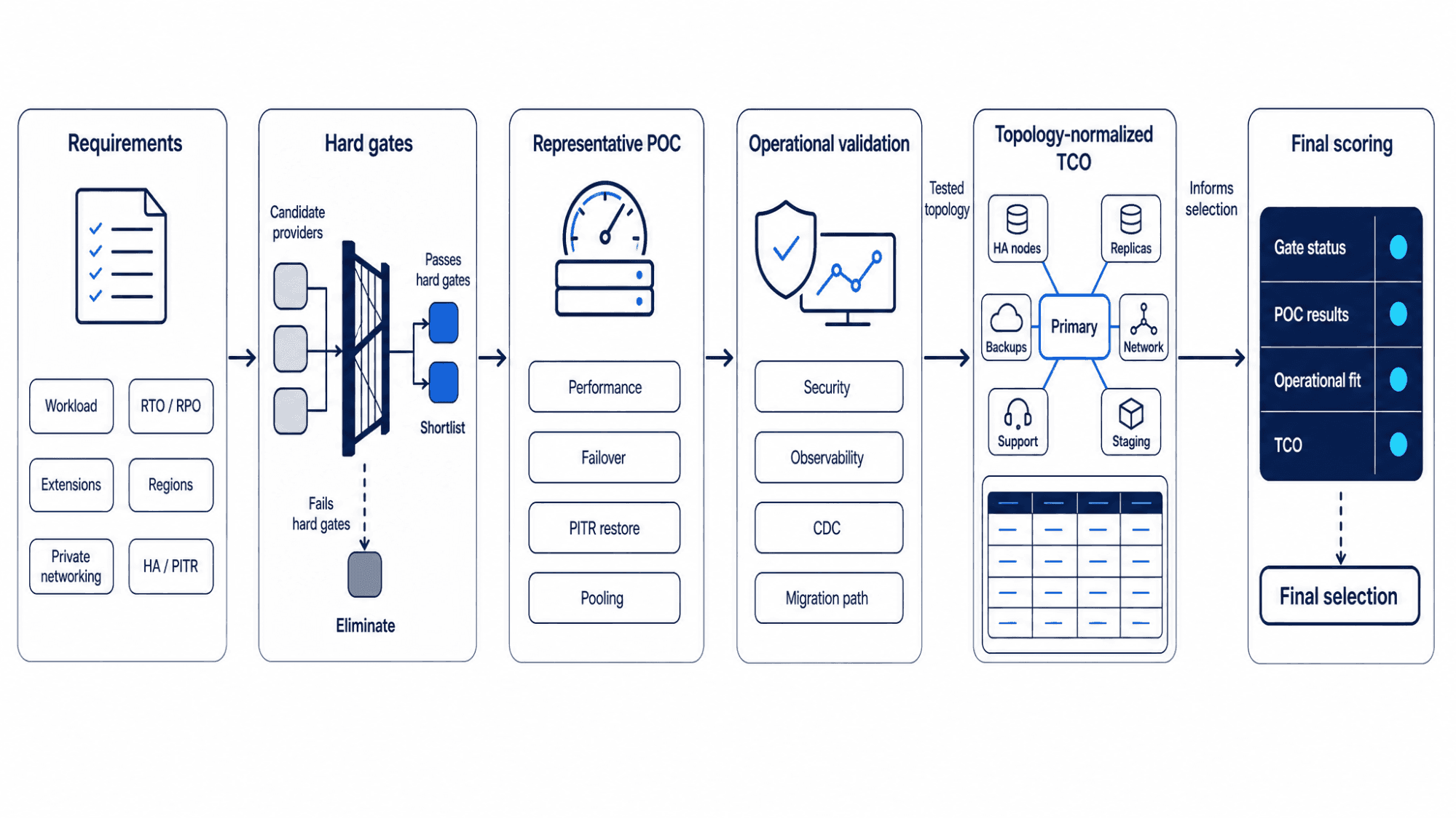
When the choice is obvious: One provider passes all gates, performs better on the POC, presents acceptable contract terms, and aligns tightly with your operating model.
When the choice is close: Compare measured recovery behavior, export path, observability, scaling costs, and alignment with your team's operating model.
Get final stakeholder sign-off on the topology, budget, migration plan, change-management plan, and rollback approach before signing.
Conclusion
Managed Postgres providers become meaningfully different once you evaluate the production topology rather than the product page. Storage architecture, replication, failover, connection handling, recovery workflows, operational controls, and cost all affect how the database behaves under the conditions your application will actually encounter.
Start by eliminating providers that fail your non-negotiable requirements. Then test the remaining options with representative data and load, including failover, PITR, connection saturation, observability, and the migration path you would depend on if you needed to leave.
For performance-critical transactional workloads, include ClickHouse Managed Postgres in that evaluation and test the standby configuration that matches your durability requirements. If analytics is creating measurable contention in Postgres, evaluate a separate ClickHouse service alongside Postgres scaling options.
The final decision should come from the production behavior you measure and the operating model your team is prepared to own.
Frequently asked questions
Which managed Postgres providers should I compare in 2026?
The relevant shortlist depends on your operating model. Compare Amazon RDS for PostgreSQL and Aurora for AWS-centric workloads, Cloud SQL and AlloyDB for GCP, Azure Database for PostgreSQL Flexible Server for Azure, Neon for serverless and branching workflows, Crunchy Bridge for specific extension or configuration requirements, and ClickHouse Managed Postgres for performance-critical transactional workloads, and Aiven when managing multiple open-source data services through one provider matters.
Apply required regions, extensions, networking, HA, recovery, privileges, and replication access as hard gates before deciding which providers belong in your POC.
What is the difference between managed PostgreSQL and a PostgreSQL-compatible database?
A managed PostgreSQL service runs PostgreSQL while transferring operational responsibilities such as backups, patching, monitoring, and failover to the provider.
A PostgreSQL-compatible service may support PostgreSQL drivers, SQL, and application interfaces while changing parts of the underlying storage, replication, extension, privilege, or operational model. If your workload depends on specific PostgreSQL internals, extensions, WAL behavior, replication, or tooling, verify those requirements explicitly.
How much does managed Postgres cost?
There is no single comparable managed Postgres price because providers use different billing models and production architectures.
Compare the cost of the topology you actually need. Include primary compute, HA standbys, replicas, storage, I/O, backups, PITR, networking, observability, support, staging environments, and migration costs. For serverless services, also model expected active compute and sustained-load behavior rather than comparing only the lowest idle price.
Should I choose serverless or provisioned managed Postgres?
Serverless Postgres can fit workloads where branching, rapid provisioning, elastic compute, or idle suspension materially improve the development or cost model.
Provisioned services can fit workloads with sustained utilization or infrastructure requirements that benefit from an explicitly sized production topology. Test both models against expected concurrency, latency, recovery requirements, connection behavior, and full production cost rather than choosing from the billing model alone.
What should I test in a managed Postgres proof of concept?
Test representative data, workload concurrency, p95 and p99 latency, failover, PITR restore, connection pooling, observability, the export path, and any required CDC, logical replication, upgrade, or migration workflows.
Use the exact HA, storage, pooling, and networking configuration you intend to deploy in production.
Is high availability the same as disaster recovery in managed Postgres?
No. HA reduces downtime from infrastructure failures within its documented fault domain. PITR restores an earlier database state after logical corruption, bad migrations, or accidental deletion.
Regional disaster recovery requires a separate cross-region recovery design with its own RTO and RPO.
When should analytics move out of Postgres?
Evaluate moving analytics out of Postgres when reporting queries, scans, or materialized-view maintenance cause persistent CPU, cache, I/O, or p99 latency contention that PostgreSQL tuning or read scaling cannot resolve within the workload's targets.
A Postgres-only architecture remains valid while transactional and reporting workloads continue to meet performance and cost requirements.
When is ClickHouse Managed Postgres a fit?
Choose ClickHouse Managed Postgres for performance-critical transactional workloads when a POC confirms that the selected zero-standby, one-asynchronous-standby, or two-synchronous-standby configuration meets your durability and recovery requirements.
Keep PostgreSQL as the system of record, and add a separately provisioned ClickHouse service only when a measurable analytics breakpoint warrants it.


