 50.5k
50.5k
A managed Postgres service should fit how an application isolates, provisions, routes, scales, recovers, and analyzes tenant data. A mismatch can create noisy-neighbor contention, exhaust connection pools, or make the cost of mostly idle tenant infrastructure difficult to justify.
Provider fit depends on both workload shape and tenancy design. Shared-schema, schema-per-tenant, separate-database, separate-service, and hybrid models place different demands on connection management, recovery, automation, and analytical infrastructure.
This guide compares seven managed Postgres options by tenancy boundary, operational mechanism, and analytical path.
TL;DR
- Separate databases inside one service improve logical separation but continue to share compute, maintenance, HA, and failure boundaries.
- Service-per-tenant designs add stronger resource boundaries only where the provider documents them, and they require routing, quota, credential, restore, and cost automation.
- Test transaction pooling with tenant context, prepared statements, temporary tables, advisory locks,
LISTEN/NOTIFY, and retries. - Keep analytics on Postgres while agreed targets hold. Add separate analytical compute only at a measured breakpoint, then re-create and test tenant authorization at the analytical serving layer.
Managed Postgres providers by multitenant SaaS requirement
Use this matrix to shortlist providers by decisive requirement, relevant tenancy boundary, documented mechanism, and the boundary to test.
| Provider | Best fit | Relevant tenancy pattern | Documented mechanisms to verify | Boundary to validate |
|---|---|---|---|---|
| Amazon RDS for PostgreSQL | Choose RDS for PostgreSQL when AWS-native IAM and networking, a required AWS region, or an established RDS operating model for the tenant fleet is decisive | Shared schema or hybrid; separate instances for selected tenants when the operating model and provisioned cost fit | RDS Proxy, APIs, Terraform, CloudFormation, and instance-scoped PITR | Per-instance capacity and recovery unit; tenant-specific replay remains an application workflow in pooled models |
| Amazon Aurora PostgreSQL | Choose Aurora PostgreSQL when AWS alignment is decisive and the aggregate tenant workload requires Aurora’s distributed-storage durability, failover, or replica-scaling model under the tested configuration | Shared-schema or hybrid deployments; separate clusters when the tenant-specific isolation requirement and cluster economics fit | Aurora Replicas, RDS Proxy, provisioned clusters, and eligible Aurora Serverless v2 auto-pause configurations | Aurora is PostgreSQL-compatible but uses a different storage engine; Serverless v2 auto-pause has configuration blockers and continuing storage charges |
| Google Cloud SQL for PostgreSQL | Choose Cloud SQL for PostgreSQL when GCP-native IAM and networking, a required GCP region, or an established Cloud SQL operating model for the tenant fleet is decisive | Shared schema or hybrid; separate instances when provisioned economics fit | Managed Connection Pooling on qualifying Enterprise Plus instances, APIs, Terraform, and the Cloud SQL Auth Proxy for secure connectivity | The Auth Proxy is not a pooler; pooling, HA, read pools, and analytical services have separate configuration and cost boundaries |
| Azure Database for PostgreSQL Flexible Server | Choose Azure Database for PostgreSQL Flexible Server when Azure identity and networking, a required Azure region or procurement path, or an established Flexible Server operating model for the tenant fleet is decisive | Shared schema or hybrid; separate servers for selected tenants when required | Built-in PgBouncer on supported tiers, ARM, Terraform, and Azure networking controls | Verify PgBouncer enablement and settings for the selected server; validate tier, region, HA, restore, and compliance requirements for the exact configuration |
| Neon | Choose Neon when branch-based preview environments or idle suspension for intermittent tenant databases are decisive, and project limits and compute reactivation fit the tested workload | Project per tenant and branch per environment for intermittent databases, previews, and trials | Projects and branches, autoscaling, idle suspension, APIs, and pooled connection endpoints | Validate current project, compute, connection, and reactivation limits; active logical replication can change idle-suspension behavior |
| Crunchy Bridge | Choose Crunchy Bridge when a required PostgreSQL extension or setting that ClickHouse Managed Postgres does not currently provide is decisive | Shared schema, hybrid, or separate clusters when provisioned economics fit | Extension and language support, the management API, and a verified Terraform provider | Verify the exact extension, setting, region, HA, migration, monitoring, routing, and fleet-workflow requirements |
| ClickHouse Managed Postgres | Choose our managed service when sustained I/O-heavy OLTP and an analytical path into a selected ClickHouse Cloud service are both decisive, and the required region and always-on fleet economics fit | Shared schema, schema per tenant, databases per tenant inside one service, or hybrid; separate services only when always-on economics and fleet mechanics fit | Local NVMe and selectable HA, bundled PgBouncer, OpenAPI CRUD, ClickPipes, and configured pg_clickhouse foreign tables | A narrower regional and ecosystem footprint; Terraform is alpha, and not offer scale-to-zero |
Tenancy patterns and their operational boundaries
The tenancy decision is not simply whether each tenant gets a different name in PostgreSQL. It is which resources and failure domains the tenants actually share.
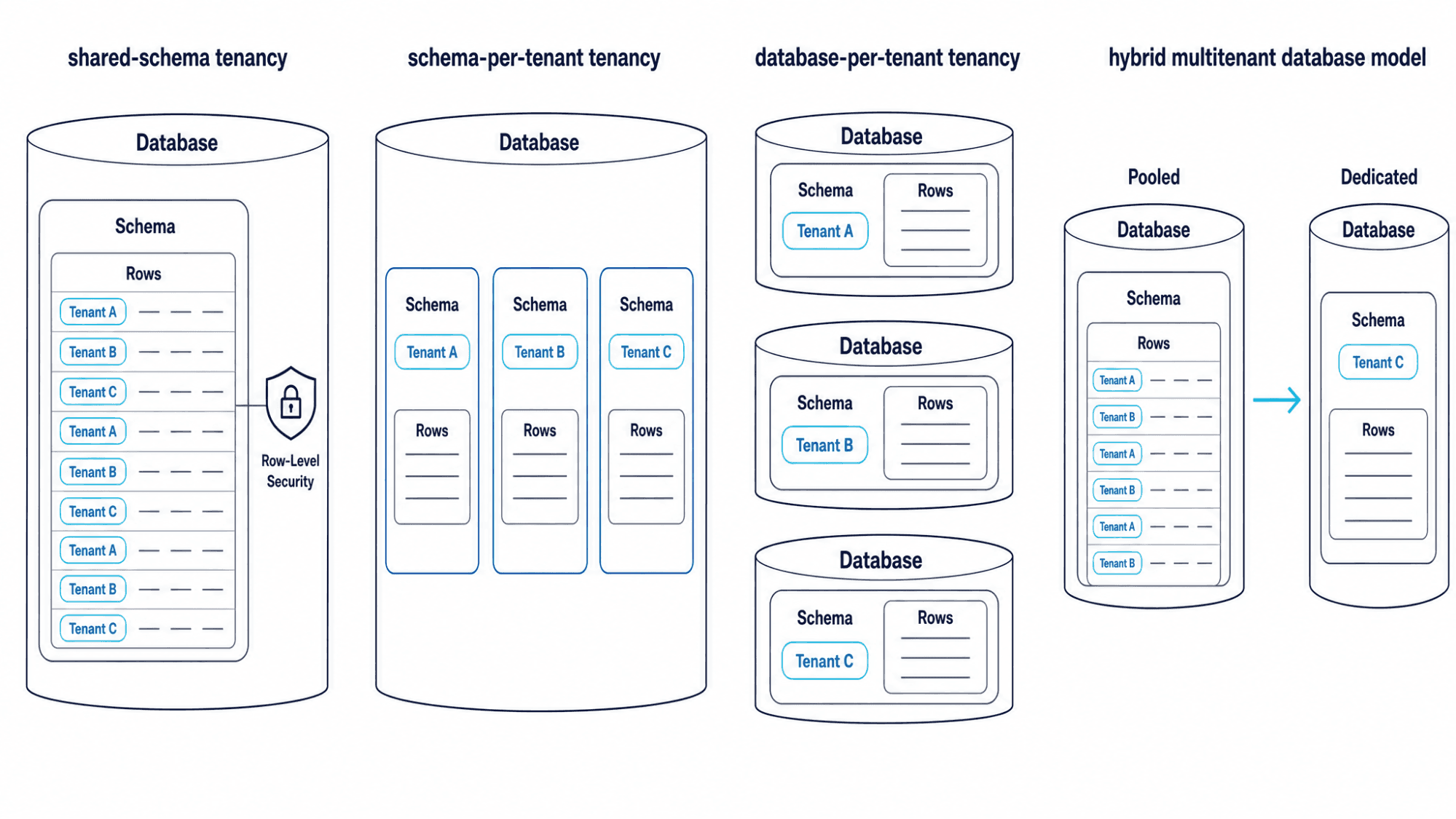
Shared-schema tenancy
In a shared-schema model, tenants use the same tables and are identified by a tenant key on each row. The application and database must apply that tenant context to every read and write. PostgreSQL Row-Level Security can enforce policies inside the database, but it does not remove the need for correct application context and testing.
PostgreSQL superusers and roles with BYPASSRLS bypass RLS. Table owners normally bypass their own policies. FORCE ROW LEVEL SECURITY subjects the table owner to RLS, but it does not cover superusers or BYPASSRLS roles. Test application, administrative, migration, background-job, SQL-console, and SECURITY DEFINER paths separately.
Shared-schema designs concentrate tenant density and reduce the number of infrastructure objects. They also share compute, storage, connections, maintenance, and recovery units. A noisy tenant, missing predicate, incorrect RLS policy, or leaked tenant context can therefore affect more than one customer.
Schema-per-tenant tenancy
Schema-per-tenant designs place tenants in separate schemas inside one PostgreSQL database. This provides a clearer logical namespace and can help with tenant-specific object customization, export, and deletion.
The schemas still share database and service-level compute, storage, connections, maintenance, HA, and failure boundaries. Migrations must fan out across schemas, and schema drift becomes a fleet concern as tenant counts grow.
Separate databases per tenant inside one PostgreSQL service
A separate database per tenant inside one PostgreSQL service improves logical separation and can simplify some ownership and export workflows. It does not create a separate provider-level operational boundary. The databases still share the service's compute, storage architecture, maintenance events, HA topology, and failure domain.
Recovery also depends on the provider's actual backup and restore unit. If PITR restores the entire service or cluster into a new resource, extracting and replaying one tenant remains an application-owned procedure even when the tenant has a separate database.
Separate service or project per tenant
A separate service, project, or cluster per tenant adds a provider-level resource boundary. It can isolate compute, maintenance, credentials, regional placement, and restore operations more strongly than separate databases inside one service.
The tradeoff is fleet operations. Teams need API-driven provisioning, tenant-to-endpoint routing, credential rotation, migrations, quotas, monitoring, cost attribution, backup testing, offboarding, and an authoritative routing catalog. For intermittently active tenants, minimum provisioned capacity and suspension behavior can dominate the cost model.
Hybrid tenancy
A hybrid model keeps tenants with similar workload and isolation requirements on shared infrastructure and moves tenants with persistent noisy-neighbor behavior, contractual isolation, regional placement, or distinct recovery requirements to separate resources.
The application must be able to move a tenant without breaking routing, credentials, migrations, audit history, or downstream analytical pipelines. The trigger for promotion should be based on measured workload or a contractual boundary, not a customer-size label.
Fleet requirements
As the number of databases, projects, or services grows, the following become platform requirements:
- Provision and decommission tenant resources through supported APIs or infrastructure as code.
- Control schema migrations and detect drift across the fleet.
- Maintain a highly available source of truth for tenant routing, endpoints, and credentials.
- Rotate secrets without losing track of long-lived clients or background workers.
- Define the provider restore unit and test tenant-specific extraction and replay.
- Measure usage and cost by tenant, database, service, region, and analytical destination.
- Define how a tenant moves between pooled and dedicated infrastructure.
Isolation, recovery, and connection requirements
Provider controls and application controls address different boundaries. A provider can isolate services, encrypt storage, and operate HA infrastructure, while the application remains responsible for tenant predicates, RLS policies, tenant-aware queues, and authorization in downstream systems.
Operational isolation
Evaluate noisy-neighbor behavior, connection exhaustion, scaling events, maintenance scope, failover boundaries, and restoration procedures. Name the resource being isolated. A separate schema, database, service, project, replica, and analytical destination each provide different boundaries.
Compare availability symmetrically. For every shortlisted configuration, document the HA topology, whether standbys can serve reads, the backup and PITR unit, whether restore creates a new resource, and how a single tenant is extracted or replayed.
Data and compliance isolation
In pooled designs, tenant isolation depends on correct context propagation, RLS or equivalent policies, authorization tests, and application-owned tenant recovery and deletion procedures. Separate resources can make some boundaries clearer, but they do not remove the need to test privileged paths and downstream copies.
Company-level compliance claims do not automatically apply to every product configuration. Verify that a required certification or control applies to the exact product, plan or tier, region, topology, and contract.
Recovery, deletion, and retention
Start with the provider's actual restore unit. Determine whether point-in-time recovery restores a database, instance, service, or cluster and whether the restored copy becomes a new resource.
In a pooled model, tenant-specific recovery often requires restoring a provider backup to a temporary resource, extracting the affected tenant's rows, validating referential integrity and authorization attributes, and replaying the data into production. Tenant deletion, retention, and legal-hold workflows also remain application-owned when a backup contains multiple tenants.
Define recovery point and recovery time objectives at both the service and tenant levels. Test the tenant procedure instead of assuming that service-level PITR satisfies it.
Connection management
Treat connection handling as a primary design constraint. Evaluate provider-native pooling, external PgBouncer compatibility, direct versus pooled endpoints, tenant-to-endpoint mapping, credential rotation, connection storms, and failure retries.
If tenant context uses session state, test it against the selected pooling mode. Under transaction pooling, set tenant context inside each transaction and verify state reset. PgBouncer documents different support boundaries for prepared statements, temporary tables, advisory locks, and LISTEN/NOTIFY. A secure connectivity proxy is not necessarily a connection pooler.
Service-per-tenant fleets also create a routing problem. The application must map every tenant to the correct endpoint, credentials, region, and lifecycle state without opening a separate long-lived connection pool for every idle tenant.
Provider-by-provider evaluation
Amazon RDS for PostgreSQL
Relevant tenancy pattern: RDS fits shared-schema and hybrid applications. A separate RDS instance can provide a stronger provider-level boundary for a selected tenant when the provisioned capacity, routing, and number of instances and related infrastructure resources fit the business requirement.
Connections and fleet: RDS Proxy, PgBouncer patterns, AWS APIs, Terraform, and CloudFormation provide several implementation paths. Validate the exact authentication, session-state, prepared-statement, and transaction-pooling behavior used by the application.
Boundary to validate: RDS point-in-time recovery creates a new DB instance. In a pooled tenancy model, extracting and replaying one tenant from that instance remains an application-owned workflow. Model compute, storage, backup, proxy, and replica costs for the selected topology and tenant duty cycle.
Amazon Aurora PostgreSQL
Aurora PostgreSQL is PostgreSQL-compatible but uses a different distributed storage engine from standard PostgreSQL.
Relevant tenancy pattern: Aurora supports shared-schema and hybrid applications. A cluster per tenant adds a stronger operational boundary but should be modeled against the tenant duty cycle and the cluster's continuing storage and infrastructure charges.
Connections and fleet: Aurora supports RDS Proxy, PostgreSQL pooling patterns, AWS APIs, Terraform, and CloudFormation. Treat provisioned Aurora and Aurora Serverless v2 as different configurations.
Boundary to validate: Aurora Serverless v2 can auto-pause only when the engine version supports a minimum of 0 ACUs, the cluster minimum is configured at 0, and no blocker is active. Open connections, RDS Proxy, PostgreSQL logical replication, Global Database configurations, and some zero-ETL topologies can prevent writer auto-pause. AWS documents a typical resume time of about 15 seconds and longer recovery after extended inactivity; storage and other cluster charges continue. Verify the current conditions in the Aurora Serverless v2 auto-pause documentation.
Google Cloud SQL for PostgreSQL
Relevant tenancy pattern: Cloud SQL fits shared-schema and hybrid applications. Separate instances can be used when the isolation requirement and provisioned cost justify a separate provider resource.
Connections and fleet: Managed Connection Pooling is available on qualifying Enterprise Plus instances. Application-level pooling remains another option. The Cloud SQL Auth Proxy provides secure connectivity but is not itself a connection pooler.
Boundary to validate: Verify the exact tier, HA topology, maintenance configuration, restore unit, pooling mode, API quota, and region. Database-per-tenant economics depend on the selected minimum compute, storage, backups, replicas, networking, and expected tenant duty cycle.
Azure Database for PostgreSQL Flexible Server
Relevant tenancy pattern: Flexible Server fits shared-schema and hybrid SaaS applications. Separate servers can provide stronger provider-level isolation for tenants with a contractual or regional requirement when the fleet model remains manageable.
Connections and fleet: Built-in PgBouncer is available on supported General Purpose and Memory Optimized configurations. Verify whether it is enabled and how it is configured on the selected server. Application-level pooling, ARM, Terraform, and Azure APIs provide additional options.
Boundary to validate: Verify the precise tier, region, HA topology, backup and restore behavior, PgBouncer settings, private-networking requirements, and plan-level compliance controls. Built-in pooling availability and compliance coverage both depend on the selected Flexible Server configuration.
Neon
Relevant tenancy pattern: Project-per-tenant and branch-per-environment workflows can fit preview environments, trials, and intermittently active databases. Validate current project, compute, connection, and API limits before treating this as a large-fleet pattern.
Connections and fleet: Neon provides pooled and direct connection endpoints, API-driven project and branch workflows, autoscaling, and idle suspension. Test tenant routing, connection storms, reactivation, migrations, backup semantics, and credential rotation at the intended project count.
Boundary to validate: Idle suspension introduces compute reactivation behavior that the application must tolerate. Sustained activity and active logical-replication subscribers can keep compute running, so model the actual workload and analytical path against the intended project count and duty cycle.
Crunchy Bridge
Relevant tenancy pattern: Crunchy Bridge can support shared-schema, hybrid, and separate-cluster designs. A cluster per tenant should be evaluated against its provisioned capacity, regional requirements, routing model, and fleet size.
Connections and fleet: Crunchy Bridge exposes a management API and a verified Terraform provider for cluster provisioning, point-in-time recovery, and read-replica operations. In a database-per-tenant design, the application still owns tenant routing and any workflow that current Crunchy Bridge documentation does not identify as provider-managed.
Boundary to validate: Confirm the exact extension and language support, PostgreSQL setting, region, HA topology, migration workflow, fleet-wide monitoring, and cost-attribution requirements. Teams must use the available provider APIs to build the required tenant-lifecycle workflows, so fleet coverage should be tested at the intended scale.
ClickHouse Managed Postgres
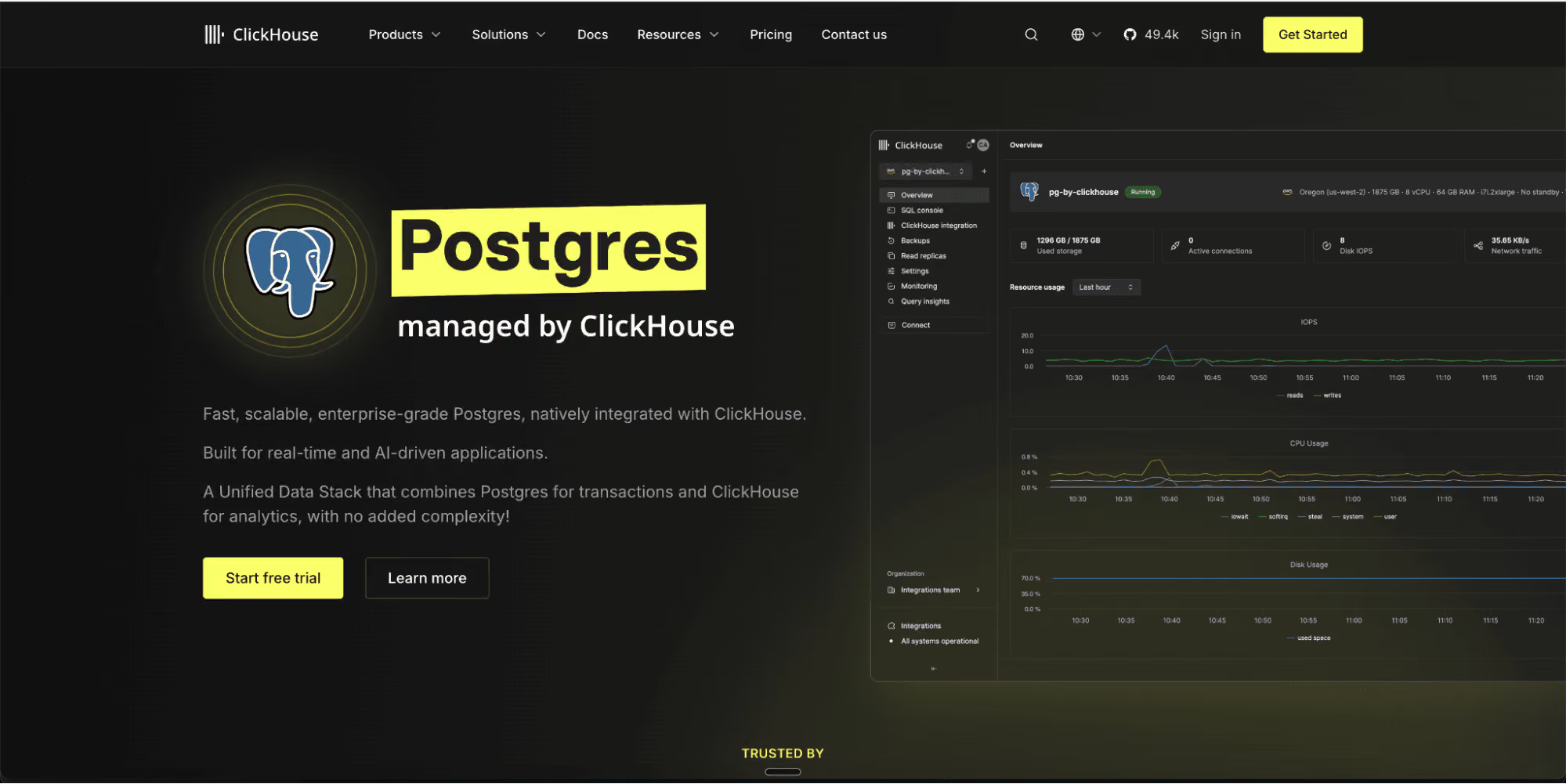
Relevant tenancy pattern: Standard PostgreSQL databases and schemas support shared-schema, schema-per-tenant, database-per-tenant inside one service, and hybrid designs. Consider a separate service per tenant only when its always-on economics, API coverage, quotas, routing, credential rotation, and offboarding model fit the intended fleet.
Connections and fleet: Bundled PgBouncer uses transaction pooling for short-lived connections. Direct PostgreSQL on port 5432 is required for server-side prepared statements and ClickPipes. Terraform provider v3.21.0 and later offers alpha support and does not cover every operation. OpenAPI supports service CRUD. Major-version upgrades currently require ClickHouse support. Self-service major-version upgrades through the UI and API and self-service maintenance-window configuration remain planned.
Architecture and HA: ClickHouse Managed Postgres stores PostgreSQL data on local NVMe physically colocated with compute. Buyers choose no standby, one asynchronous standby, or two synchronous standbys based on durability and performance requirements. One asynchronous standby can miss recently acknowledged commits during failover. With two synchronous standbys, a write waits for at least one standby acknowledgement. HA standbys are reserved for failover and do not serve reads. See High availability.
Recovery: Point-in-time recovery creates a new instance and leaves the original instance unchanged. In pooled designs, tenant-specific extraction and replay remain application-owned. Backup retention depends on the selected commercial tier.
Analytics path: Teams select or create a ClickHouse Cloud destination, create and configure a ClickPipe, and choose which Postgres tables to replicate. ClickPipes maintains an eventually consistent analytical copy with seconds-level freshness. The default 60-second synchronization interval controls how often ClickPipes pulls changes; it is not an end-to-end freshness measurement or guarantee. See Sync to ClickHouse.
ClickPipes isolates destination query compute but does not eliminate source-side work. Source Postgres still performs logical decoding, retains WAL, serves the initial snapshot, and transfers data over the network. Monitor source resource use and replication lag.
pg_clickhouse is preinstalled, but users must configure the ClickHouse Cloud connection and foreign tables for selected ClickHouse Cloud tables. It can push supported filters, joins, semi-joins, aggregations, and functions down to ClickHouse Cloud. Unsupported operations execute in Postgres, and mixed plans can return rows to Postgres for local execution. See the ClickHouse Managed Postgres overview.
The ClickHouse Cloud analytical destination and any dedicated Postgres read replicas are separate services billed separately from the primary. HA standbys are not read replicas. Model all required components with the current pricing documentation and pricing calculator.
Boundary to validate: It is available on AWS in supported ClickHouse Cloud regions, so verify availability for the required region during procurement. Choose a hyperscaler-managed option when native cloud IAM, networking, a required region, or an established cloud operating model is decisive. Currently does not support scale-to-zero, so a service-per-tenant evaluation should model the selected full-VM configuration and fleet quotas.
The measurable breakpoint for analytical offload
Run analytics on Postgres while measured transaction latency, reporting latency, resource use, and cost targets are met. Add dedicated analytical compute when persistent CPU or I/O contention, missed transaction or dashboard latency targets, scan-driven primary overprovisioning, excessive reporting maintenance, data volume, or concurrency crosses an agreed threshold.
After that breakpoint, define the complete path:
- Keep Postgres as the transactional system of record.
- Identify which tables and columns are copied and how deletions and schema changes are handled.
- Measure source snapshot work, logical decoding, WAL retention, network transfer, and replication lag.
- State where analytical queries execute and which operations can fall back to Postgres.
- Define destination recovery, monitoring, and separate billing.
- Re-create and test tenant authorization in the analytical application layer.
Replicate tenant identifiers, then enforce equivalent authorization in the analytical database or application API before exposing results. CDC does not carry PostgreSQL RLS policy semantics to the analytical copy.
Comparing analytical paths for multitenant SaaS
Analytics becomes a multitenancy concern when reporting for one tenant consumes CPU, I/O, memory, or connections needed by transactional traffic, or when fleet-wide reporting must combine data from separate tenant databases or services. Copying data into another system also creates a new authorization and cost-attribution boundary.
Use this table only after the measured breakpoint above has been crossed. For each path, identify what is copied, where queries execute, what work remains on the source, the consistency model, and what is billed separately. Verify that tenant identifiers reach the analytical serving layer, re-create and test authorization there, and ensure that workload and cost can be attributed at the required tenant, cohort, database, or service level. A read replica, federated query, CDC copy, and foreign-table query do not provide the same isolation.
| Provider | Documented mechanism | User configuration and ownership | What is copied and where queries run | Source-side or shared-resource work | Freshness and consistency | Prerequisites, maturity, and separate billing |
|---|---|---|---|---|---|---|
| Amazon RDS for PostgreSQL | Eligible RDS zero-ETL integration with Amazon Redshift; read replicas, logical replication, and DMS are separate alternatives | Configure an eligible RDS source and Redshift target, create the integration, and authorize the target | Zero-ETL copies supported transactional data into Redshift, where analytical queries execute | Source and target configuration plus source-side replication and WAL work remain | Asynchronous copy; measure lag for the exact workload rather than treating configuration cadence as a guarantee | Engine version, region, source and target settings, and topology eligibility apply; Redshift is provisioned and billed separately |
| Amazon Aurora PostgreSQL | Eligible zero-ETL integrations with Redshift or SageMaker Lakehouse; replicas and DMS are separate mechanisms | Configure the required cluster parameters, eligible source and target, integration, and authorization | Supported data is copied to the selected analytical destination; queries execute there | Replication work remains on the source; logical replication and some zero-ETL configurations can affect Serverless v2 auto-pause | Asynchronous; verify lag and consistency for the eligible configuration | Version, region, topology, and destination eligibility apply; analytical services are billed separately |
| Google Cloud SQL for PostgreSQL | Datastream into BigQuery; read pools and BigQuery federation are distinct alternatives | Create the PostgreSQL source connection profile, Datastream stream, and BigQuery destination | Datastream copies changes into BigQuery; read pools remain PostgreSQL; federation queries Cloud SQL in place | CDC requires source logical-decoding and network work; federation continues to consume source resources | CDC is asynchronous; federation has no copied analytical state | Datastream, BigQuery, and qualifying read pools have separate configuration and billing |
| Azure Database for PostgreSQL Flexible Server | Fabric Mirroring | Enable Fabric Mirroring, configure managed identity and a replication role, then select the database and tables | Selected tables are initially copied and subsequent changes are captured through azure_cdc and delivered to OneLake for analytical queries | Snapshotting, CDC, WAL retention, and data transfer create source-side work | Asynchronous batches; Microsoft does not provide a fixed end-to-end latency SLA | Fabric Mirroring is generally available for PostgreSQL 14, 15, 16, 17, and 18; other configuration prerequisites apply; source permissions are not propagated; Fabric capacity is separate |
| Neon | PostgreSQL logical replication into a selected warehouse or OLAP destination | Enable logical replication, create a publication and replication role, and configure and operate the external subscriber | The selected replication system copies data to its destination, where queries execute | Logical-replication connections and source work remain; an active subscriber can prevent idle suspension | Asynchronous and eventually consistent; behavior depends on the selected destination | Destination provisioning and billing are separate; validate plan and logical-replication requirements |
| Crunchy Bridge | On AWS, Crunchy Data Warehouse replication into Iceberg | Configure the warehouse replication path and select the source tables to copy | Selected Crunchy Bridge Postgres tables are copied into Iceberg and queried through the warehouse path | Logical decoding, initial-copy work, WAL retention, and network transfer remain on the source | The apply worker batches changes every 30 seconds; Crunchy documents typical end-to-end lag below 60 seconds, not a universal guarantee | AWS scope applies; the warehouse is provisioned and billed separately |
| ClickHouse Managed Postgres | ClickPipes CDC into a selected ClickHouse Cloud service; configured pg_clickhouse foreign tables are a separate query-access mechanism | Select or create the ClickHouse Cloud destination, create and configure the ClickPipe, and select tables; configure the connection and foreign tables separately for pg_clickhouse | ClickPipes copies selected tables into ClickHouse Cloud, where analytical queries execute; pg_clickhouse pushes only supported operations | Logical decoding, initial snapshotting, WAL retention, and network transfer remain; unsupported or mixed pg_clickhouse work can execute in Postgres | Seconds-level freshness and eventual consistency; the default 60-second pull interval is not an end-to-end freshness measurement or guarantee | ClickPipe, selected tables, destination, connection, and foreign tables require setup; ClickHouse Cloud and read replicas are billed separately |
These mechanisms create different multitenant boundaries. A PostgreSQL read replica can move reporting reads away from the primary, but it does not by itself isolate tenants from one another. A federated query continues to consume resources on the transactional source. A CDC copy moves analytical query execution to separate compute, but it introduces eventual consistency, source replication work, destination operations, separate billing, and another authorization boundary.
Choose a separate analytical path only when the measured improvement in transactional or reporting targets justifies its full-topology cost and operating burden. Otherwise, a Postgres-only topology remains valid.
How to choose a managed Postgres provider
Apply these gates in order:
- Define the tenancy unit. Distinguish shared schemas, separate schemas, separate databases in one service, and separate services or projects.
- Apply hard constraints. Check required cloud, region, identity, networking, compliance, PostgreSQL behavior, extension coverage, and procurement.
- Model workload and economics. Use tenant density, duty cycle, utilization, latency tolerance, and current minimum-capacity costs.
- Validate operational mechanics. Test connection storms, pooling mode, failover, migrations, backup and restore, tenant replay, API quotas, routing, credential rotation, and offboarding.
- Measure the analytics breakpoint. Keep reporting on Postgres while agreed SLOs and cost targets hold. If they do not, evaluate each analytical path's copied data, source work, consistency, execution location, authorization, and separate billing.
Conclusion
Choose a managed PostgreSQL service based on the actual tenancy boundary, hard platform constraints, fleet duty cycle, connection behavior, recovery unit, and measured workload. A Postgres-only architecture remains valid while transaction and reporting targets continue to hold.
When sustained I/O-heavy OLTP and a separate analytical path are both decisive, our managed service can replicate selected tables into a selected ClickHouse Cloud service and expose configured ClickHouse Cloud tables through partial pg_clickhouse pushdown. Verify required region and lifecycle coverage, and include the separately billed ClickHouse Cloud service in the cost model. Start with PostgreSQL, scale with ClickHouse.
Frequently asked questions
What should a multitenant Postgres proof of concept test?
Test normal and noisy-tenant transaction latency, connection storms, transaction-pooling behavior, failover, maintenance, backup and restore, tenant-specific replay, provisioning quotas, routing, credential rotation, and cost at the expected tenant duty cycle. If analytics is in scope, measure snapshot impact, replication lag, source WAL growth, destination query latency, and authorization behavior.
Does database-per-tenant guarantee operational isolation?
No. Separate databases in one PostgreSQL service still share service-level compute, storage architecture, maintenance, HA, and failure boundaries. A separate service or project per tenant adds a provider-level boundary but requires more fleet automation and per-tenant capacity modeling.
Should multitenant SaaS analytics run directly on Postgres?
A Postgres-only topology remains valid while transactions and reporting meet latency, throughput, maintenance, and cost targets. Add dedicated analytical compute when measured contention, missed SLOs, overprovisioning, maintenance burden, data volume, or concurrency justifies it.
How does transaction pooling affect tenant context?
Set tenant context inside each transaction and test state-reset behavior. Verify prepared statements, temporary tables, advisory locks, LISTEN/NOTIFY, retry behavior, and every privileged path against the selected pooler.


