50.4k
50.4k


Postgres extensions add functionality that Postgres itself does not include. Examples include PostGIS for geospatial data, pgvector for embeddings, and TimescaleDB for time-series. Via extensions the Postgres ecosystem distributes new functionality; just CREATE EXTENSION to hook into Postgres internals, and thereafter the user mostly forgets about it.
Foreign Data Wrapper extensions, also known as “FDW”s, teach Postgres how to read (and sometimes write) data outside of Postgres. Simply declare a foreign table:
CREATE FOREIGN TABLE events (...)
SERVER my_clickhouse OPTIONS (table 'events');Then SELECT * FROM events resembles a query against any other table. Internally, Postgres asks the FDW to fetch the data from elsewhere.
pg_clickhouse, the FDW we maintain, fetches data from ClickHouse. While people often rely on the unified data stack — Postgres for transactional data and ClickHouse for analytics — pg_clickhouse executes SQL queries on both systems. As we worked on it for the past 6 months, we found that a single question drives most of the engineering work: how much of a query do we send across the wire as SQL versus how many rows do we drag back as data?
That question encompasses the meaning of pushdown: how much work can we “push down” to the remote service? The answer seems simple: “send everything!” — the WHERE clause, the GROUP BY, the LIMIT. But a closer examination reveals the complexity: Some clauses we can send. Some we can almost send — if we rewrite them. Some we used to send but stopped, because they returned the wrong results. And some clauses can never be sent by any FDW, regardless of the engineering one throws at them.
We’ve found the process of making these determinations highly iterative.
To demonstrate, let’s examine the impact of that iteration on a single query: what gets pushed down, what doesn't, and how we continuously modified the code in response to the question.
The goal is to illuminate the inner workings of an FDW for people who’ve heard of FDWs but don’t know how they work in detail. Whether you're a Postgres user curious about ClickHouse, a ClickHouse user curious about Postgres, or someone thinking about writing an FDW yourself, we hope you find this exercise edifying.
The query that takes 80 ms or 4 minutes
This query ranks the busiest web events in the last week for the US, UK, and DE, by country and event name. It reports volume, unique users, premium share, p95 latency, and each event’s rank by country, returning the top 100 rows overall to provide a small snapshot and avoid streaming raw events.
SELECT
u.country,
e.event_name,
count(*) AS n,
count(DISTINCT e.user_id) AS unique_users,
count(*) FILTER (WHERE e.properties->>'tier' = 'premium') AS premium_count,
percentile_cont(0.95) WITHIN GROUP (ORDER BY e.duration_ms) AS p95_ms,
ROW_NUMBER() OVER (PARTITION BY u.country ORDER BY count(*) DESC) AS rank_in_country
FROM events_ch e JOIN users_ch u USING (user_id)
WHERE e.ts >= now() - interval '7 days'
AND u.country IN ('US', 'UK', 'DE')
AND e.properties->>'platform' = 'web'
GROUP BY u.country, e.event_name
ORDER BY n DESC
LIMIT 100;events_ch and users_ch are foreign tables backed by ClickHouse. With every clause in this query pushed down, it returns 100 rows in roughly 80 ms.
If a single clause fails to push down, the query takes minutes. We built support for pushing down the window function, the percentile, the JSON access, and the FILTER aggregate; but each was, at some earlier point, not yet pushed down. When an operation cannot be pushed down, the rest of the query can't push down either; rows that should have been aggregated remotely must stream back to Postgres so it can aggregate them locally. The wire ends up carrying tens to hundreds of millions of rows instead of 100.
Pushdown looks like a feature, but it’s really an agreement between two SQL grammars, revised for every Postgres release. This explains why the pg_clickhouse release notes often look like corrections: revoking incorrect array-function pushdown, adding safer functions like levenshtein and soundex, and respecting planner invariants like EvalPlanQual even when the remote could move faster.
What the FDW actually negotiates
An FDW does not send the original Postgres query to the remote database; doing so causes errors where the SQL dialects differ. But ideally, It also does not pull every row back unless it has to (as simple FDWs like file_fdw do), because although the results would be correct, execution would be slow.
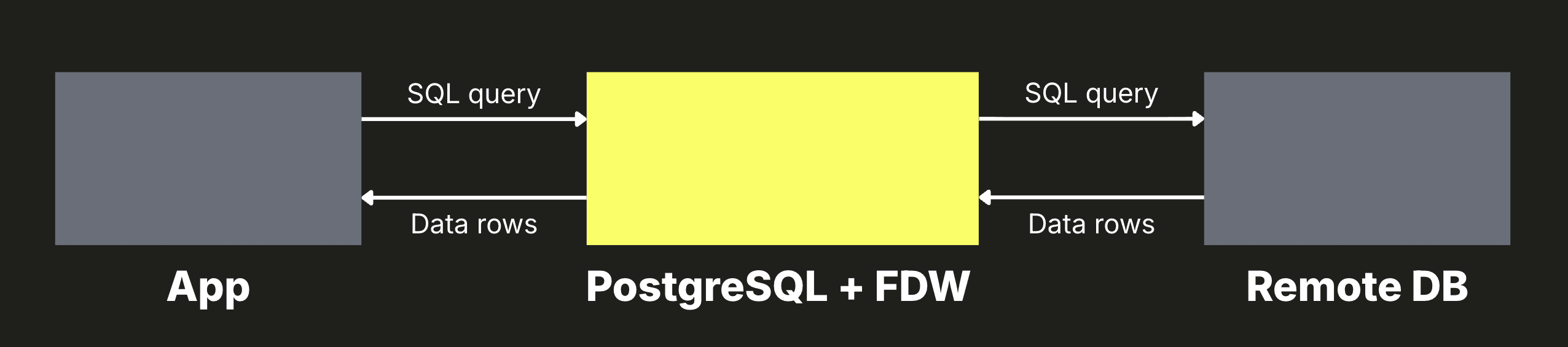
Postgres does not directly decide that a scan, join, aggregate, sort, or limit can be executed in ClickHouse. Instead, it asks the FDW to contribute foreign paths to the planner via the FDW planning callbacks. pg_clickhouse registers these planning callbacks:
routine->GetForeignRelSize = clickhouseGetForeignRelSize;
routine->GetForeignPaths = clickhouseGetForeignPaths;
routine->GetForeignPlan = clickhouseGetForeignPlan;
routine->GetForeignJoinPaths = clickhouseGetForeignJoinPaths;
routine->GetForeignUpperPaths = clickhouseGetForeignUpperPaths;GetForeignPaths, GetForeignJoinPaths, and GetForeignUpperPaths tell the planner what can be pushed down. If the planner selects one of those paths, GetForeignPlan builds the plan and generates the ClickHouse SQL.
These callbacks are just entry points; pg_clickhouse’s callback functions verify that each clause or expression can be translated without changing the result. Of course it started out quite simple: just a few clauses and expressions inherited from the original fork from postgres_fdw. Thus pg_clickhouse initially pushed down count(*) but not count(*) FILTER (...), couldn’t push down percentile_cont or JSON predicates like properties->>'platform': because it did not know how.
Thus, pushdown is not a yes/no decision for a whole query, but constitutes a series of smaller decisions: does Postgres expose the hook, can pg_clickhouse translate the expression, and can ClickHouse execute it with the same meaning?
The progression: one query, every step we've shipped
To answer the question, "why doesn’t X push down?" let’s look at one realistic query and walk it through everything pg_clickhouse has shipped. Same query, seven steps. Each step pushes down more to ClickHouse; Postgres must evaluate what remains after pulling back the rows it needs to do so.
Each step examines the same query. Lines marked ✓ push down at that step; lines marked ✗ remain local. Each step also marks a real date in our history, when the relevant pushdown landed in the codebase, or when we expect to ship it. Each step demonstrates what the query plan looked like as of that date.
Step 1: scan + simple WHERE
Inherited from the original clickhouse_fdw via initial port e5035bc (October 2, 2025). Available in pg_clickhouse since v0.1.0 (December 9, 2025).
The starting point is deliberately small: pg_clickhouse only pushes down predicates it can translate with confidence. Comparisons like >=, membership checks like IN, and simple timestamp arithmetic are safe to push down because Postgres and ClickHouse have clear equivalents for them. In other words, those filters run in ClickHouse rather than collecting all the rows to evaluate in Postgres.
SELECT
u.country, -- ✗
e.event_name, -- ✗
count(*) AS n, -- ✗
count(DISTINCT e.user_id) AS unique_users, -- ✗
count(*) FILTER (WHERE e.properties->>'tier' = 'premium') AS …, -- ✗
percentile_cont(0.95) WITHIN GROUP (ORDER BY e.duration_ms) AS …, -- ✗
ROW_NUMBER() OVER (PARTITION BY u.country ORDER BY count(*)) AS … -- ✗
FROM events_ch e -- ✓ scan only
JOIN users_ch u USING (user_id) -- ✗
WHERE e.ts >= now() - interval '7 days' -- ✓
AND u.country IN ('US','UK','DE') -- ✓
AND e.properties->>'platform' = 'web' -- ✗
GROUP BY u.country, e.event_name -- ✗
ORDER BY n DESC -- ✗
LIMIT 100 -- ✗At this point, only the base-table filters push down. The SQL translator (internally called a “deparser”) emits one remote scan for events with the timestamp predicate, and one remote scan for users with the country predicate. It sends these two separate queries to ClickHouse and collects the results. Everything that combines rows or changes their shape, including the join, grouping, aggregates, window function, sort, and limit, runs inside Postgres against those retrieved rows. Thus the wire must carry every matching events row from the last seven days, plus every matching users row, before Postgres can reduce the result to 100 rows.
The point is that even the simplest pushdown is already a translation problem: now() can be pushed down as now(), while interval '7 days' is translated as 7 * 86400. Those mappings live in src/custom_types.c, where pg_clickhouse records the expressions it knows how to translate safely for ClickHouse. The steps outlined below expand that vocabulary from base filters to joins, aggregates, windows, and limits.
Step 2: + JOIN pushdown
Inner-JOIN deparse came from the original clickhouse_fdw, but the inherited cost estimates were placeholders, and the Postgres planner often pulled rows back to join locally rather than push. Commit b345682 (December 1, 2025) replaced them with row-count-based estimates and cost-based scans higher than join paths, so the planner reliably picks the pushed plan. Plus 6a297ec (Nov 13, 2025) for join_use_nulls outer-join semantics. All shipped in v0.1.0 (December 9, 2025).
At this step pg_clickhouse stops treating events_ch and users_ch as two independent remote scans. Since both tables live on the same ClickHouse server and the join condition has a ClickHouse equivalent, the FDW can ask ClickHouse to make the join before any joined rows cross the wire.
SELECT ... -- ✗ (still)
FROM events_ch e -- ✓
JOIN users_ch u USING (user_id) -- ✓ joins push
WHERE e.ts >= now() - interval '7 days' -- ✓
AND u.country IN ('US','UK','DE') -- ✓
AND e.properties->>'platform' = 'web' -- ✗ stays local
GROUP BY u.country, e.event_name -- ✗
ORDER BY n DESC -- ✗
LIMIT 100 -- ✗The remote SQL is now roughly SELECT * FROM events ALL INNER JOIN users USING (user_id) WHERE …. The ALL keyword is deliberate: ClickHouse's default join can return only one matching row, while a Postgres inner join returns all matches. Emitting ALL INNER JOIN preserves Postgres semantics. The JSON predicate still cannot be translated at this point, so it is left out of the remote WHERE and applied locally to the returned rows.
Postgres enabled this kind of join pushdown in 9.6 (commit e4106b25287, 2016, Etsuro Fujita). Previously, FDWs had to hook deeper into the planner to accomplish join pushdown.
For our query, this single step reduces query time from roughly 30 minutes to 30 seconds, because the join filters rows before they leave the remote.
Step 3: + GROUP BY + simple aggregates + ORDER BY + LIMIT
Also inherited via e5035bc. GROUP BY, basic aggregates (count, sum, min, max, avg), ORDER BY, and LIMIT all pushdown since v0.1.0 (December 9, 2025).
This step emphasizes result-shaping work: grouping rows, computing basic aggregates, sorting the grouped result, and applying the final limit. Postgres exposes these operations as “upper” planning stages, and the FDW can offer a remote version of each stage when the whole stage can be represented in ClickHouse. Aggregate pushdown arrived in Postgres 10 (commit 7012b132d07); ORDER BY and LIMIT pushdown followed in Postgres 12.
Still, at this point pg_clickhouse cannot push down all of the operations: The grouping stage must encompass the entire SELECT list, and it hasn’t been wired to push down three expressions:
count(*) FILTER (WHERE e.properties->>'tier' = 'premium'): the FILTER body contains a JSON op without a pushdown mappingpercentile_cont(...) WITHIN GROUP (ORDER BY ...): ClickHouse has an equivalent function, but pg_clickhouse hasn’t mapped itROW_NUMBER() OVER (...): window functions have not been mapped to ClickHouse equivalents at all
Note that grouped pushdown is all-or-nothing for a given grouped result. So even though count(*), count(DISTINCT), GROUP BY, ORDER BY, and LIMIT are individually fine, the grouped part of this particular query still remains local.
SELECT
u.country, e.event_name, -- ✗ grouped result blocked
count(*) AS n, -- ✗ blocked
count(DISTINCT e.user_id) AS unique_users, -- ✗ blocked
count(*) FILTER (WHERE e.properties->>'tier' = 'premium') AS …, -- ✗ FILTER body has JSON
percentile_cont(...) AS p95_ms, -- ✗ no mapping yet
ROW_NUMBER() OVER (...) AS rank_in_country -- ✗ window not remote yet
FROM events_ch e -- ✓
JOIN users_ch u USING (user_id) -- ✓
WHERE e.ts >= ... ✓ AND u.country IN (...) -- ✓
AND e.properties->>'platform' = 'web' -- ✗
GROUP BY u.country, e.event_name -- ✗ blocked
ORDER BY n DESC -- ✗ blocked
LIMIT 100 -- ✗ blockedA simpler subset of this query (drop the FILTER, percentile, and ROW_NUMBER) would push down fully at this point:
-- The subset that DOES push down at Step 3:
SELECT u.country, e.event_name, count(*) AS n, count(DISTINCT e.user_id) AS unique_users
FROM events_ch e JOIN users_ch u USING (user_id)
WHERE e.ts >= now() - interval '7 days' AND u.country IN ('US','UK','DE')
GROUP BY u.country, e.event_name
ORDER BY n DESC LIMIT 100;That subset deparses as a single ClickHouse SELECT statement, with count(DISTINCT e.user_id) emitted as a ClickHouse count(DISTINCT user_id). The full, richer query needs three more steps to fully land.
Step 4: + ordered-set aggregates (percentile_cont → quantile)
Commit 087cfdc (November 10, 2025), in v0.1.0. Previously, percentile_cont blocked the upper rel for any query that used it.
This step teaches pg_clickhouse one more aggregate translation: Postgres percentile_cont(p) WITHIN GROUP (ORDER BY x) can be expressed as ClickHouse quantile(p)(x). This change removes the percentile from the list of blockers. The allow list remains narrow: for example, pg_clickhouse still refuses string_agg(... ORDER BY ...) because ClickHouse's closest equivalent does not preserve the same within-group ordering semantics.
SELECT
... -- ✗ still blocked
percentile_cont(...) AS p95_ms, -- ✓ now shippable
ROW_NUMBER() OVER (...) AS rank_in_country -- ✗ window not remote yet
FROM ... -- (everything else unchanged from Step 2-3)The percentile_cont function becoming individually shippable is necessary but not sufficient. The grouped result still can't be pushed down because two blockers remain: FILTER-with-JSON and the ROW_NUMBER window function.
But take note of the recurring pattern over the course of these steps: a translation lifts one pushdown blocker at a time, but pushdown of the full query occurs only when all such blockers have been resolved. This explains how a stream of single-translation changes to pg_clickhouse, individually modest, compound over time to suddenly push down a full query that previously ran entirely locally.
Step 5: + JSON sub-column access (->, ->>)
Commits 0b4c03e (April 2, 2026) and 669924a (April 3), in v0.1.6 / v0.2.0. Previously, every ->/->>/jsonb_extract_path was a local filter; even e.properties->>'platform' = 'web' couldn't pushdown.
This step adds JSON field access to the shared vocabulary. A Postgres JSON accessor expression like e.properties->>'platform' now translates to the ClickHouse sub-column expression e.properties.platform, so JSON predicates need no longer wait for rows to be fetched back to Postgres.
SELECT
u.country, e.event_name, -- ✗ still blocked (window)
count(*) AS n, count(DISTINCT e.user_id) AS unique_users, -- ✗ blocked (window)
count(*) FILTER (WHERE e.properties->>'tier' = 'premium') AS …, -- ✓ FILTER body now lifts
percentile_cont(...) AS p95_ms, -- ✓
ROW_NUMBER() OVER (...) AS rank_in_country -- ✗ window still blocks
FROM events_ch e -- ✓
JOIN users_ch u USING (user_id) -- ✓
WHERE ...
AND e.properties->>'platform' = 'web' -- ✓ JSON qual lifts
GROUP BY u.country, e.event_name -- ✗ still blocked
ORDER BY n DESC -- ✗ blocked
LIMIT 100 -- ✗ blockedTwo things change at once:
- The
properties->>'platform' = 'web'predicate ships asproperties.platform = 'web', so ClickHouse can filter those rows before sending them back. - The filtered aggregate
count(*) FILTER (WHERE properties->>'tier' = 'premium')pushes down ascountIf(properties.tier = 'premium'), using ClickHouse's conditional aggregate form.
The grouped result still does not push down, but now there is only one blocker left: ROW_NUMBER.
Step 6: + window functions
Commit 0caf913 (April 2, 2026, same day as JSON sub-column access), in v0.1.6 / v0.2.0. Previously, any OVER (...) clause blocked the upper rel.
This step lets pg_clickhouse offer a remote plan for window functions. ROW_NUMBER, RANK, DENSE_RANK, LEAD, LAG, FIRST_VALUE, LAST_VALUE, NTH_VALUE, and MIN/MAX OVER all run in ClickHouse when their partition keys and order keys can also be translated.
Here pg_clickhouse exceeds the pushdown of its ancestor, postgres_fdw, which does not push down window functions. But ClickHouse executes them quickly and close to the data, a benefit that greatly outweighs the overhead of translating the functions.
SELECT
u.country, -- ✓
e.event_name, -- ✓
count(*) AS n, -- ✓
count(DISTINCT e.user_id) AS unique_users, -- ✓
count(*) FILTER (WHERE e.properties->>'tier' = 'premium') AS …, -- ✓
percentile_cont(0.95) WITHIN GROUP (ORDER BY e.duration_ms) AS …, -- ✓
ROW_NUMBER() OVER (PARTITION BY u.country ORDER BY count(*)) AS …,-- ✓
FROM events_ch e -- ✓
JOIN users_ch u USING (user_id) -- ✓
WHERE e.ts >= now() - interval '7 days' -- ✓
AND u.country IN ('US','UK','DE') -- ✓
AND e.properties->>'platform' = 'web' -- ✓
GROUP BY u.country, e.event_name -- ✓
ORDER BY n DESC -- ✓
LIMIT 100 -- ✓No impediments to pushdown remain. The join, grouping, aggregates, window function, ordering, and limit all become one ClickHouse query. What used to be a Postgres plan with separate Limit / Sort / WindowAgg / Group / Join / Scan / Scan nodes collapses into a single foreign scan whose remote SQL looks roughly like:
-- What lands on the ClickHouse wire:
SELECT
u.country,
e.event_name,
count(*) AS n,
count(DISTINCT e.user_id) AS unique_users,
countIf(e.properties.tier = 'premium') AS premium_count,
quantile(0.95)(e.duration_ms) AS p95_ms,
ROW_NUMBER() OVER (PARTITION BY u.country ORDER BY count(*) DESC) AS rank_in_country
FROM events e
ALL INNER JOIN users u USING (user_id)
WHERE e.ts >= now64(9, 'UTC') - INTERVAL 7 DAY
AND u.country IN ('US','UK','DE')
AND e.properties.platform = 'web'
GROUP BY u.country, e.event_name
ORDER BY n DESC
LIMIT 100;(Approximate; the exact count(DISTINCT) and countIf deparse have edge cases not shown here.)
The wire carries 100 rows. Postgres receives them and returns them. Compared to Step 1, where the wire carried tens of millions of rows, the difference is several orders of magnitude.
Historical context
The reaction we sometimes see, "I'm surprised this expression wasn't pushed down from day one," is what you get when you look at the list of v0.2 changes without the context of history. Walking the query through that history surfaces a few facts that a simple list of changes does not, to whit:
- Pushdown is granular. Each clause must be independently negotiated. A clause that looks "obvious" can fail to push down because of a single sub-expression:
count(*) FILTER (WHERE json_op)waits on the JSON op even though count and FILTER are individually fine. - Pushdown is all-or-nothing at the upper-rel level. A grouped query can only be pushed down if the whole grouped relation can be represented safely in ClickHouse SQL. One unsupported aggregate or sub-expression can block the entire grouped plan. Put another way, adding support for a small missing translation can unlock pushdown for the full query.
- Most "improvements" are translations, not new features.
percentile_cont,ROW_NUMBER,->>. Postgres has them, ClickHouse has them. What was missing was the deparser code connecting the two grammars. Such improvements resemble new capabilities, but internally they're just new mappings incustom_types.cand the code to translate them. - Some pushdowns get revoked. Both pg_clickhouse and
postgres_fdwhave lists of pushdowns that were removed because they turned out to leak. In our v0.2.0 we revoked pushdown forarray_dims,array_lowerand friends. On the postgres_fdw side,8cfbac1492b(PG 17) refusedFETCH FIRST n WITH TIES;5c571a34d0e(PG 18) refused LIMIT pushdown where backward cursor scans would be required. This is the system working: better to pull back when we can't get the semantics right than to ship wrong rows fast.
If the deparse contract is violated, we error rather than guess
Conclusion
Pushdown looks binary from the outside: either a clause runs remotely, or it does not. Inside an FDW, it’s a contract. Postgres has to expose the right planner hook, pg_clickhouse has to translate the expression without changing its meaning, and ClickHouse has to support the same semantics. If any part of that chain is missing, the safe answer is to keep the work local or to fail loudly.
Hence FDW work often looks incremental from the outside. JSON sub-columns, percentile_cont, filtered aggregates, window functions, join semantics, DML support: each represents a small agreement between two SQL systems. But once the last blocker to pushdown lifts, the effect is not small. A query that used to stream millions of rows into Postgres can collapse into a single ClickHouse SELECT that returns 100 rows.
Pushdown is not a race to ship every clause remotely. Some translations are added. Some are revoked. Some wait on Postgres planner support. Some wait on ClickHouse engine behavior. And some should never be pushed at all, because the remote system cannot honestly promise the same answer Postgres would produce.
The work is not to make ClickHouse pretend to be Postgres. The work is to decide, clause by clause, where the two systems can agree.
Every byte kept off the wire is a byte that all three parties have agreed to omit.
Try Postgres managed by ClickHouse
ClickHouse + Postgres has become the unified data stack for applications that scale. With Managed Postgres now available in ClickHouse Cloud, this stack is a day-1 decision.
Get access