 50.2k
50.2kDuring this past Black Friday and Cyber Monday, a minute of downtime can cost our merchants $5.1 million. That's why observability is critical, we need to detect issues and prevent any downtime. We saw around a 16x improvement out of the box with ClickHouse once we had it deployed, and at peak performance over 30x. And for us, less compute is money.
Managed ClickStack
Observability for OpenTelemetry at scale
Never sample. Retain everything. Unlimited queries.
Stop choosing between cost and clarity and losing those events which matter.
With full-fidelity, long-term OpenTelemetry data, you gain complete visibility for your users and agents, removing blind spots and enabling faster MTTR and true RCA.
- Never sample, roll up, or discard high cardinality telemetry
- Indefinite retention of high-cardinality logs, metrics, trace at sub-cent per GB storage pricing
- Unlimited fast queries and atleast 10x compression
- 10x-100x more cost effective
Trusted for observability by





ClickHouse played an instrumental role in helping us develop and ship Claude 4. With ClickHouse, the database is green, queries are lightning-fast, and money is not on fire. ClickHouse has already delivered significant value in helping us create state-of-the-art language models.
Previously, querying the last 10 minutes would take 1-2 minutes. With ClickStack, it was just a case of how fast I could blink. The performance is real. When you're digging into logs during an incident, every second matters.
The observability solution powered by ClickHouse Cloud

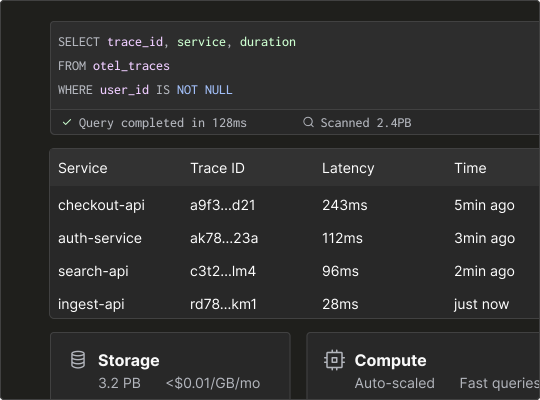
Sub-second queries
Even on hundreds of petabytes of high cardinality unsampled OpenTelemetry data.

Full stack OTel observability
Unify Session Replays with OTel Logs, Traces and Metrics.

Market leading cost efficiency
30x OpenTelemetry compression with object storage and flexible compute for major cost savings.

Unlimited retention
Separation of storage and compute, means long-term retention for less than a cent per GB per month.
Ingest everything. Retain everything.
Handle petabytes of OpenTelemetry data with the full power of open source ClickStack. Delivered as a simple, fully managed service.
- No sampling
- No rollups
- No retention tradeoffs
Managed ClickStack scales storage and compute independently to petabytes, exploiting 30x compression and object storage to let you retain high-cardinality data long term at less than a cent per GB while keeping queries fast and costs predictable.
Store everything. Scale flexibly.
ClickHouse's full separation of storage and compute enables flexible scaling and long term retention without operational tradeoffs.
- Low cost object storage by default
- Node level caching for sub second queries
- Dynamically scalable compute
Compute runs independently in front of storage and can be scaled vertically or horizontally based on workload demands.
Isolate resources for ingestion, querying, dashboards, or alerting workloads so heavy reads or bursts of traffic never impact critical pipelines.
ClickStack
Compute groups
Node
Node
Node
Node
Node
Node
Node
Data Cache
Process data
in parallel
in parallel
Process data
in parallel
in parallel
Process data
in parallel
in parallel
Process data
in parallel
in parallel
Object
storageInfinite
retention
storageInfinite
retention

Unlock your agentic observability workloads
Built-in collaborative AI workflows with Notebooks
ClickStack provides a native, AI-assisted notebook experience where SREs and AI work together to investigate systems.

Intelligent investigation
AI-assisted analysis across logs, metrics, traces

Hybrid interaction
Natural language + SQL workflows

Transparent operations
Visible reasoning, auditable queries

Collaborative workspaces
Persistent, shareable environments
Loading video...

Enterprise-grade observability, made simple
Getting started with Managed ClickStack takes minutes. Specify how much data you plan to ingest, create your service, start sending and enjoy enterprise-grade capabilities out of the box.

Uncompromising reliability
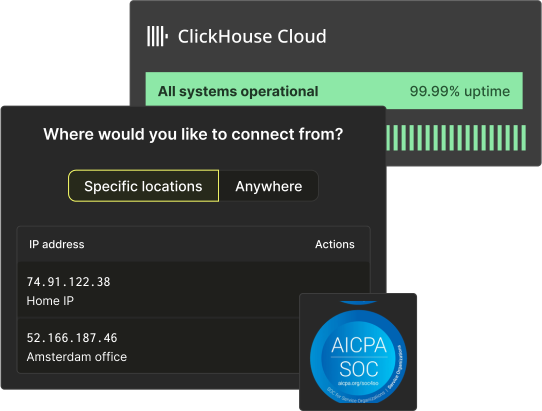
Replicated across multiple availability zones by default, ClickHouse Cloud provides high availability, seamless upgrades, automated backups, and built-in disaster recovery.

World-class security
Enterprise-grade security is built in from day one. ClickHouse Cloud offers strong user and network access controls, encryption in transit and at rest, comprehensive activity logging, and SOC 2 Type II compliance.

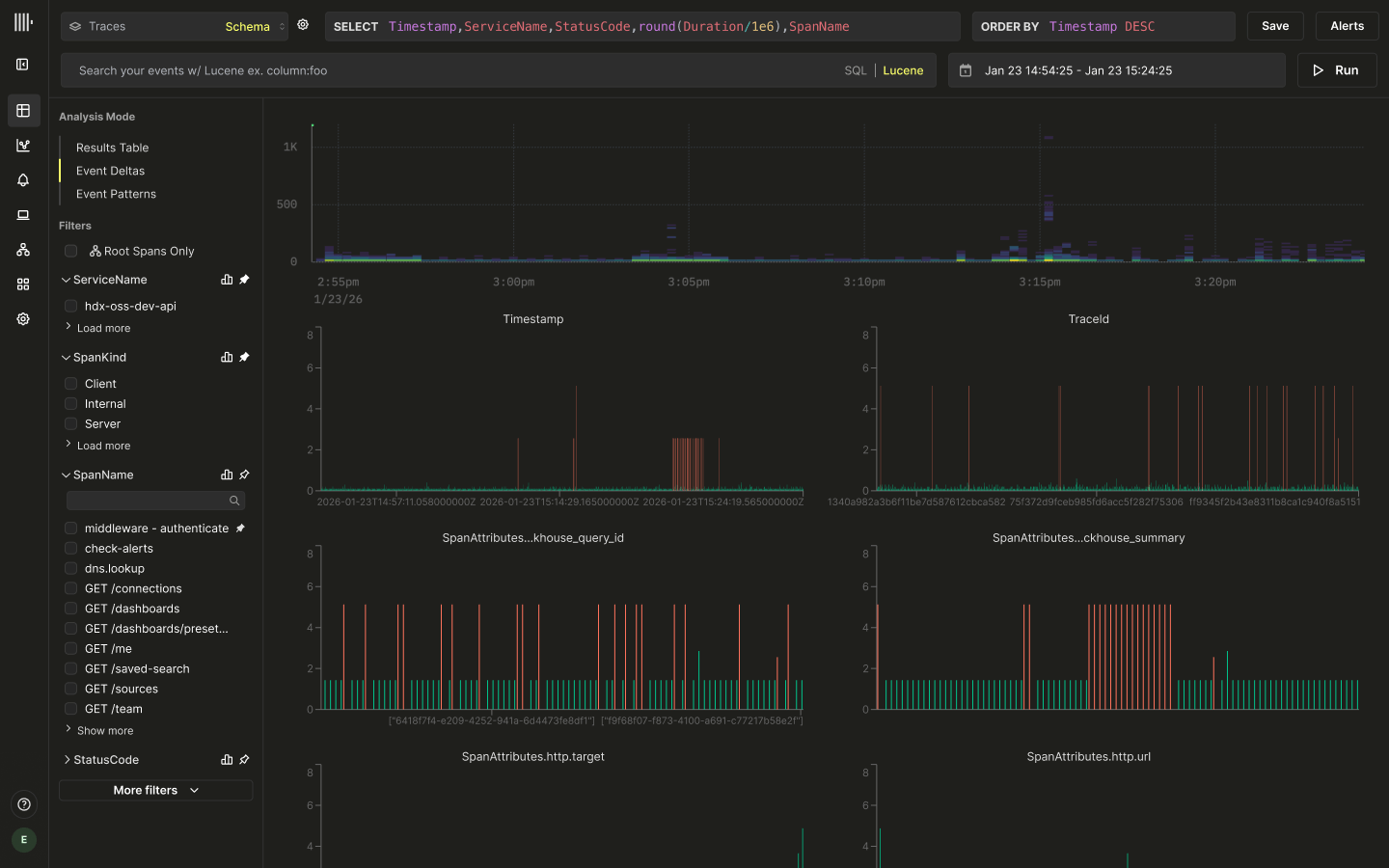
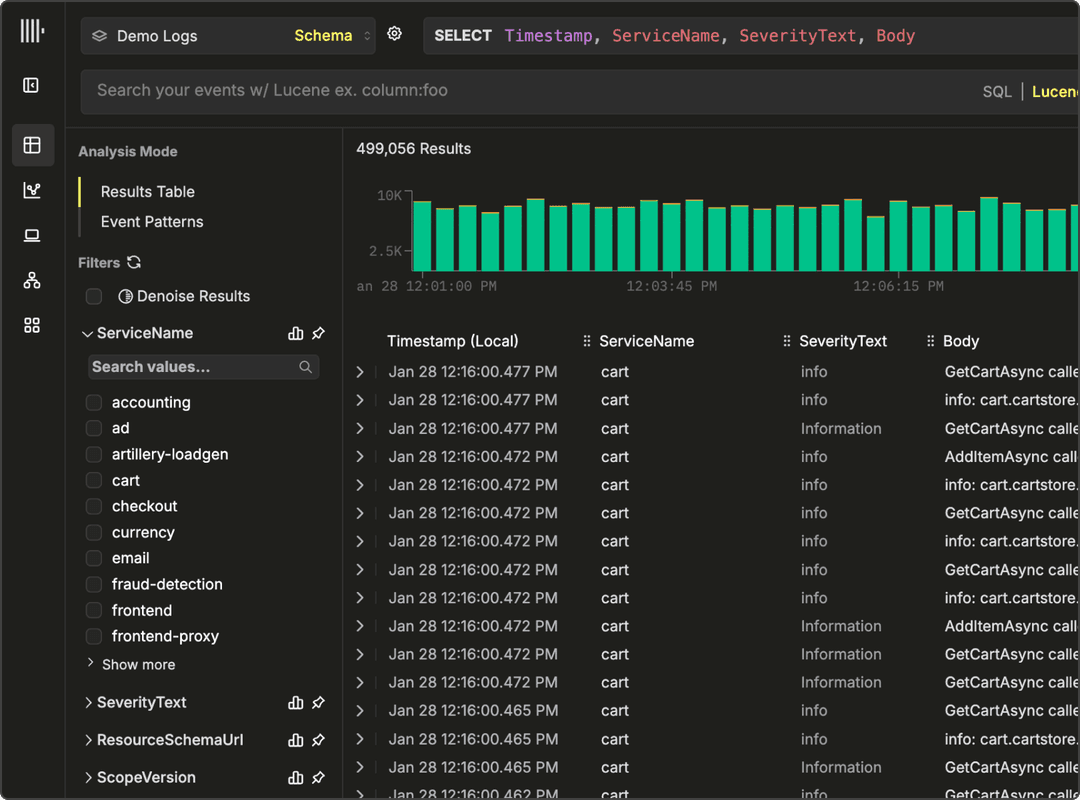
ClickStack unifies logs, metrics, traces, and session replays in one platform via the ClickStack UI (HyperDX). Optimized for ClickHouse, it supports fast Lucene-style search and full SQL access for advanced analysis and deeper analysis powered by over 100+ built-in functions.
Create dashboards and alerts with minimal setup. Spot anomalies with event deltas and speed up root cause analysis using event patterns.
Powered by ClickHouse Cloud, ClickStack searches terabytes of OTel data in seconds and ingests billions of high-cardinality events daily with optimized OTel schemas out-of-the-the-box.
ClickHouse Cloud's brings scaling and cost efficiency through full separation of storage and compute. Ingestion and queries can be completely isolated on dedicated resources, thanks to compute-compute separation. This ensures consistent performance at any scale while allowing further cost-efficiency optimizations to be made.
ClickStack natively supports the OpenTelemetry standard, capturing logs, metrics, and traces as wide events - context-rich records that unify observability data in ClickHouse. Designed for OTel data at Petabyte scale.
With native JSON support, ClickHouse efficiently handles evolving, semi-structured data. Fields are created automatically on ingest, with compressed columnar storage delivering fast queries and high compression with no upfront schema required.
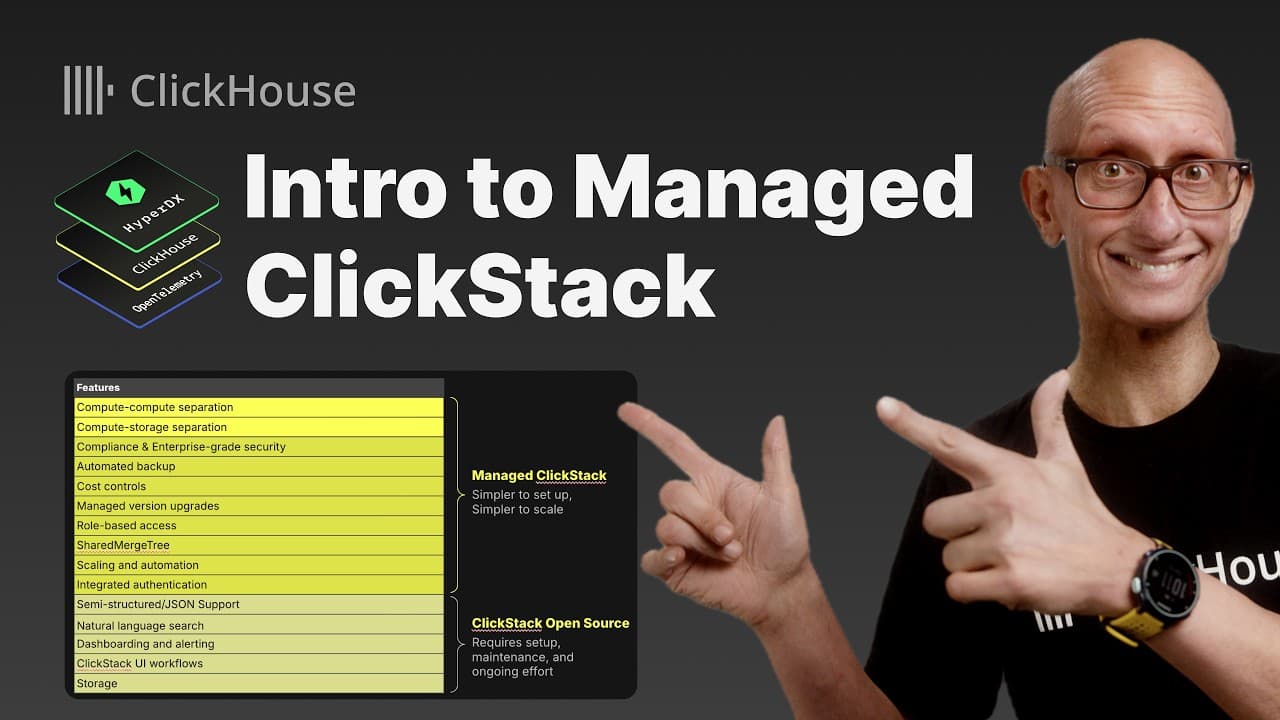
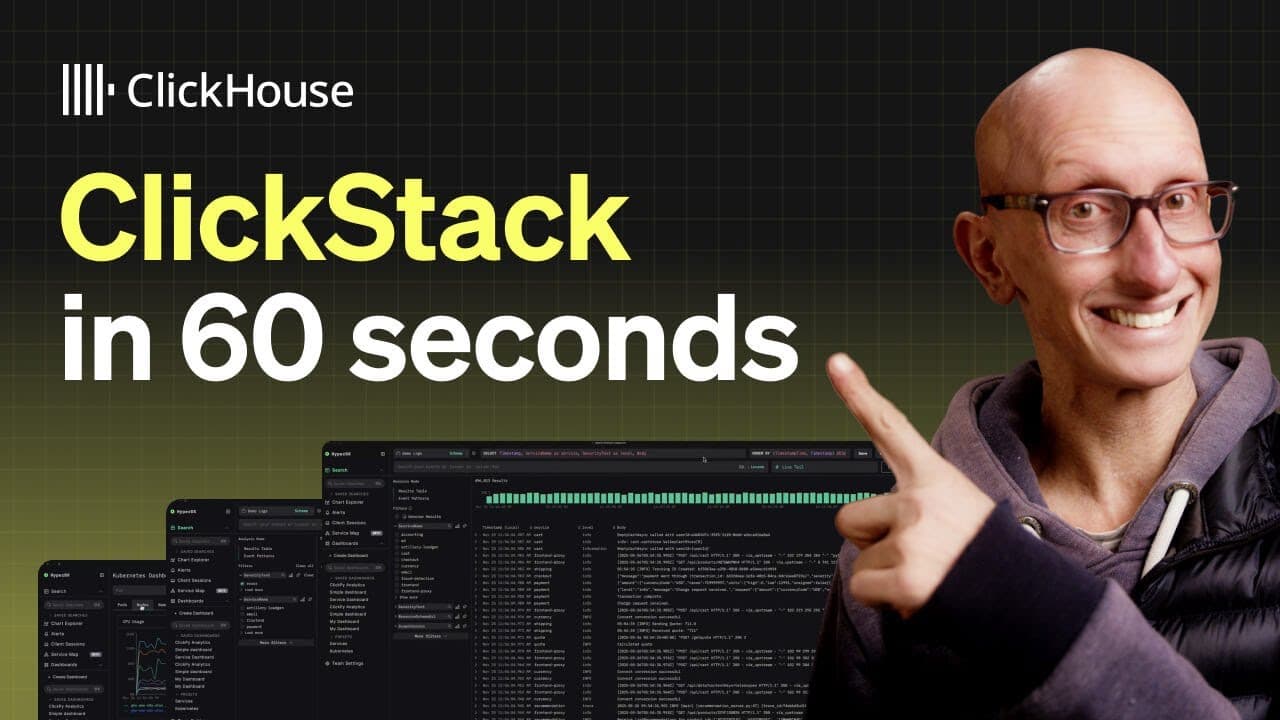
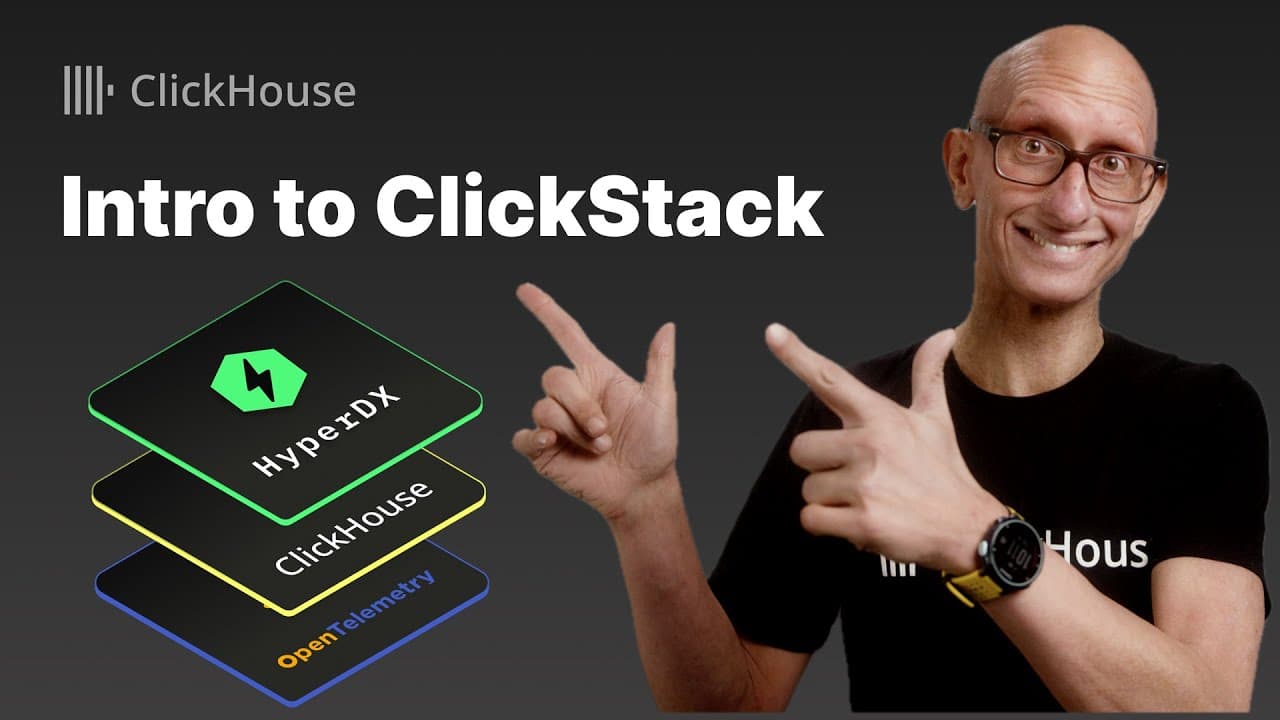
Introduction to Managed ClickStack
Intuitive observability workflows
- Intuitive observability UI for incident-driven workflows
- Lucene-style search and SQL, side by side
- Automatic correlation of logs, traces, and metrics
- Service Maps, patterns, clustering, and dashboards built in
- ClickHouse-native optimizations for fast queries at scale
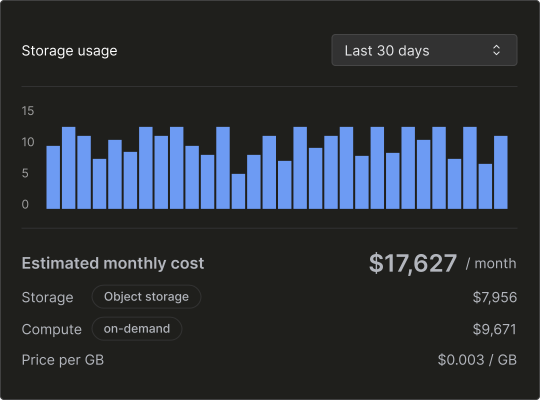
Only pay for the compute you need, when you need
ClickHouse Cloud lets you match compute to how your observability data is used, with dedicated resources for ingestion, separate pools for common queries on recent data, and on-demand compute for long-tail or historical analysis.
With isolated read and write paths and independent scaling, combined with the ability to idle or pause unused compute, you only pay for resources while they are actively in use.
Why use Managed ClickStack for your observability?
Reduce your observability costs
Managed ClickStack combines ClickHouse's open source efficiency with cloud-native storage and compute separation to deliver low-cost observability at any scale.
Ingestion and queries scale independently, data is retained indefinitely on object storage, and columnar compression reduces OpenTelemetry data by up to 90 percent, eliminating the need for sampling or short retention windows even at petabyte scale.

Simple deployment and maintenance
Managed ClickStack deploys in a few clicks. Specify your monthly OpenTelemetry ingest and start sending data in standard formats while backups, upgrades, scaling, and maintenance are handled automatically with no infrastructure to manage.
Separation of storage and compute enables near-infinite scale while ingest and query compute can be isolated to ensure predictable performance and optimize cost.

Real-time observability
ClickHouse Cloud is built for continuous, high-volume ingestion, supporting gigabytes per second while making data searchable in seconds. Materialized views compute common metrics at insert time, to selectively accelerate query time workloads.
The ClickStack UI automatically uses these views to keep dashboards fast and interactive, even across hundreds of petabytes of high-cardinality data.

Beyond observability
The engine behind Managed ClickStack, ClickHouse Cloud, is more than an observability store. It is a high-performance SQL analytics database with fully managed ingestion through ClickPipes, including sources like Kafka, and native data lake support for querying data directly in your data lake.
Observability becomes part of a broader analytics workflow, letting you join telemetry with business and security data in one system and analyze it through BI tools, notebooks, and dashboards for deeper correlation.
Subscribe to our observability newsletter
Stay informed on ClickStack feature releases, product roadmap, support, and cloud offerings!
Instrument your applications
Trace every log, API request, DB query, and more with just a few lines of code. Instrument and observe your stack in minutes with ClickStack.


Try ClickStack in ClickHouse Cloud
Experience the full power of HyperDX + ClickHouse in just minutes. We'll get you started on a 30 day trial and $300 credits to spend at your own pace.

FAQs
We're here to make observability simple, fast, and open. Explore our FAQs to learn more about Managed ClickStack, and if you don't see what you need, we're always happy to chat.
01
Managed ClickStack is the fully managed version of the open source ClickStack observability stack, running on ClickHouse Cloud. It delivers the same high-performance, open source foundation for logs, metrics, traces, and session replays, without the operational burden of running and maintaining the underlying ClickHouse infrastructure.
ClickHouse Cloud handles cluster management, scaling, upgrades, and reliability for you, while adding enterprise-grade capabilities such as separation of storage and compute and low-cost object storage for long-term retention. This lets you retain high-cardinality OpenTelemetry data indefinitely, minimize costs, and focus entirely on observability and insights rather than platform operations.
02
At a glance, Managed ClickStack and Elastic Cloud look familiar. Both provide an end-to-end observability stack with data collection, storage, and a UI for search, dashboards, and analysis. OpenTelemetry and Beats serve similar roles, HyperDX and Kibana feel conceptually alike, and both platforms aim to make large-scale observability data accessible.
The key difference lies in the underlying architecture. Elastic Cloud is built on Elasticsearch, a distributed search engine optimized around inverted indices and shard-based storage. This works well for text search, but comes with higher storage overhead, limited compression, and increasing contention between ingest and query workloads as data volumes and cardinality grow. Elastic Cloud's serverless offerings improve operational simplicity and long-term retention through object storage, but the core search-centric architecture remains.
Managed ClickStack is built on ClickHouse Cloud, a column-oriented analytics engine designed for high-cardinality data and fast aggregation at scale. Columnar storage enables dramatically higher compression, while massively parallel query execution delivers faster aggregations and analytics across large datasets. In ClickHouse Cloud, separation of storage and compute allows low-cost object storage for long-term retention, independent scaling of ingest and query workloads, and predictable performance as data grows.
The result is a platform that feels familiar to users of Elastic, but delivers lower storage costs, faster analytical queries, and greater efficiency for real-time observability and long-term analysis at petabyte scale.
For more details on how ClickStack compares with the ELK Stack see our comparison guide.
03
The ClickStack consists of three core components:
- ClickHouse - The columnar database powering fast, cost-efficient queries and compression.
- ClickStack UI (HyperDX) - The unified UI for search, dashboards, alerts, and session replays.
- OpenTelemetry - Standardized data collection for logs, metrics, and traces.
Together, they form a single, integrated observability stack optimized for speed, scalability, and simplicity.
04
Yes. Managed ClickStack is built for OpenTelemetry at any scale. Via an OpenTelemetry Collector users can ingest OTel events to ClickHouse - combining logs, metrics, and traces into a unified model.
Although Managed ClickStack is OpenTelemetry-native, it also supports any wide event format. While OpenTelemetry schemas are provided out of the box, users can bring their own - just include a timestamp, and the UI with ClickHouse delivers the same powerful querying, correlation, and visualization capabilities.
05
No. While Managed ClickStack is optimized for the OpenTelemetry schema, making it the fastest way to get started and scale easily, it's not limited to it. ClickHouse, the database powering ClickStack, can store and query any event schema.
Only a timestamp field is required to render and visualize events, so you can use your own data formats or custom pipelines. By following a wide events pattern and including a timestamp, your data becomes immediately usable.
06
Yes. Managed ClickStack is a full observability solution designed to handle logs, traces and metrics in one place. Built on ClickHouse, it efficiently ingests and stores high-cardinality OpenTelemetry data, automatically correlating events at the database layer for deep, real-time insights.
07
Yes. Managed ClickStack uses ClickHouse, which is columnar by default, and supports optional inverted indices at the column level. You can enable inverted indices and bloom filters to accelerate log and text search, which is common for log data exploration. The ClickStack UI (HyperDX) accepts Lucene-style syntax, transpiles it to SQL, and can leverage these indices for speed. If you want to minimize storage, you can disable indices and rely on ClickHouse's fast, multi-parallel string search, which is sufficient for many use cases.
08
ClickStack Open Source is the open source observability stack built on ClickHouse. It includes the ClicKStack UI (HyperDX) and optimized schemas for logs, metrics, traces, and session replays. You run and manage ClickHouse yourself, including cluster setup, scaling, upgrades, backups, and security. This option gives you full control and flexibility, but also full responsibility for operating the database.
Managed ClickStack is the fully managed version of ClickStack, running on ClickHouse Cloud. You get the same open source core and user experience, but without the operational overhead of managing ClickHouse. Cluster management, scaling, upgrades, backups, and reliability are handled for you, and authentication and user management are fully integrated with ClickHouse Cloud.
Managed ClickStack also includes additional platform capabilities that are not available when running ClickHouse open source alone. This includes cloud-native separation of storage and compute, independent scaling of read and write paths, and low-cost object storage that enables near-limitless retention.