

- the body of
Data,Totals,Extremes,Log, andProfileEventspackets in the native TCP protocol (theTableColumnspacket is not a Native block — it carries two binary strings, so its layout belongs to the native protocol spec); - the output of
SELECT ... FORMAT Nativeover HTTP; - file exports written with
INTO OUTFILE ... FORMAT Native; - inter-server replication payloads.
Overview
Everything that carries rows on the wire is a Block: a self-describing chunk of rows stored column by column. All values of column 1 come first, then all of column 2, and so on. A Block carries only the columns the query references, never the full table. A column’sdata is laid out according to the family its type belongs to. The families, in increasing decoder complexity, are:
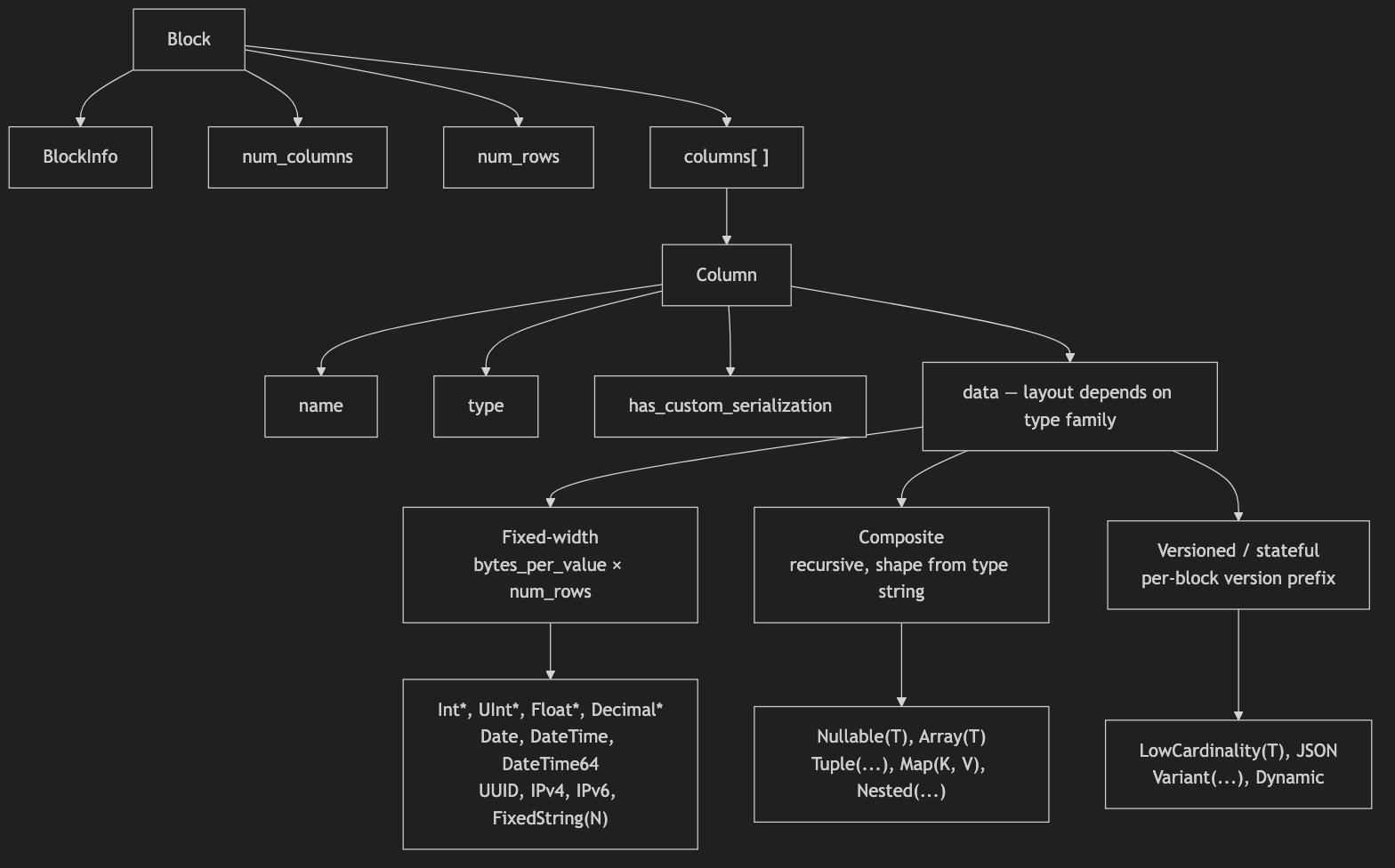
- Fixed-width types lay
dataout asbytes_per_value × num_rowsraw bytes, with no per-row framing. - Composite types (
Nullable,Array,Tuple,Map,Nested) have a recursive shape fully derivable from the type string, with no version prefix and no cross-block state. - Versioned / stateful types (
LowCardinality,JSON,Variant,Dynamic) begin each non-empty block with a serialization-version/state prefix. Over theNativewire this prefix and any dictionary are per block — the format carries no state across blocks (the writer creates fresh serialization state for every block and setslow_cardinality_max_dictionary_size = 0). Cross-block state is a MergeTree on-disk concern, not the Native wire layout.
Wire primitives
The Native format builds on four primitive encodings.VarUInt
A variable-length unsigned integer using LEB-128 encoding. Each byte carries 7 data bits in positions 0–6 and 1 continuation bit in position 7. The continuation bit is1 when more bytes follow and 0 on the final byte.
Encoding the value
300:
0xAC 0x02:
Fixed-width integers
For example, the UInt32 value
1 encodes as 01 00 00 00, and the Int32 value -1 as FF FF FF FF.
String
A length-prefixed byte sequence:0x00 byte, and strings may contain any byte values, including embedded NUL. The string "ab" encodes as 02 61 62; to decode, read the VarUInt length (2), then read that many bytes.
Bool
A single byte.0x00 is false; any non-zero value is true (canonically 0x01).
Block and column structure
Block wire layout
BlockInfo prefix is present depends on the channel, because the writer is parameterized by a revision (see Protocol revision and the Native format for the full treatment, including the output-only nature of client_protocol_version):
-
On the native TCP protocol, the server writes blocks at the connection’s negotiated revision (a large value —
DBMS_TCP_PROTOCOL_VERSION, seesrc/Core/ProtocolDefines.h).BlockInfois written whenever that revision is greater than zero, which is always the case for a real connection. Thehas_custom_serializationbyte in each column (see column wire layout) is written at revision54454and above. -
The
Nativeoutput format —SELECT ... FORMAT Nativeover HTTP,INTO OUTFILE ... FORMAT Native, and theNativeformat produced byclickhouse-client— serializes at revision0by default. At revision0theBlockInfoprefix and thehas_custom_serializationbyte are both omitted, so a block is justnum_columns,num_rows, and the columns. Over HTTP this revision is not fixed: a client may raise it with the?client_protocol_version=<n>query parameter, and the server uses that value as the serialization revision for the response. With a high enough value the HTTP output includes theBlockInfoprefix (written whenever the revision is greater than0) and thehas_custom_serializationbyte (written at revision54454and above), exactly as on the TCP path. Clients must therefore not assume that every HTTPFORMAT Nativepayload is revision0.
BlockInfo prefix describe the TCP Data-packet payload. The same query taken through FORMAT Native produces the shorter form shown alongside them.
BlockInfo
BlockInfo is a sequence of fields, each preceded by a VarUInt field ID, terminated by a field ID of0. The wire format is not self-describing: a field ID does not encode the length or type of its value, so a reader must already know the type of every field ID it might encounter. ClickHouse’s own reader treats an unrecognized field ID as corruption and raises an exception (UNKNOWN_BLOCK_INFO_FIELD). Forward compatibility is handled instead by the protocol revision: the sender only writes a field if the negotiated revision is at least that field’s minimum revision, so an older receiver never sees a field it does not know.
Fields
1 and 2 have minimum revision 0, so they are present whenever a BlockInfo is written at all. Field 3 is written only at revision 54480 and above. Wire layout for the common case (revision below 54480):
Column wire layout
A Column appearsnum_columns times within a Block.
A decoder dispatches on the
type string. Type strings often carry parameters in parentheses; the decoder strips the (...) suffix to find the base type and then parses the parameters for size, scale, or inner-type decisions. Parsing a parameter list with nested types (a Tuple inside an Array, say) needs a depth-aware comma splitter that tracks parenthesis nesting rather than a naive split on ,.
Binary type encodingThe
type field is a textual String only in the default mode. When the query setting output_format_native_encode_types_in_binary_format = 1 is set, this field is instead a binary type encoding — the same tag-based encoding documented in data type binary encoding — and flattened Dynamic type lists use the same binary encoding for their per-type names. A decoder that always reads field 2 as a length-prefixed string would treat the first binary type tag as a string length and desynchronize, so it must know which mode the stream uses.For a query with query_kind = SECONDARY_QUERY (sent by another server for remote, Distributed or parallel replicas, or by clickhouse-client --query_kind secondary_query), both peers ignore output_format_native_encode_types_in_binary_format and input_format_native_decode_types_in_binary_format for the blocks of that query: they carry textual type names in both directions. Servers that predate this rule apply these settings to a secondary query like to any other query.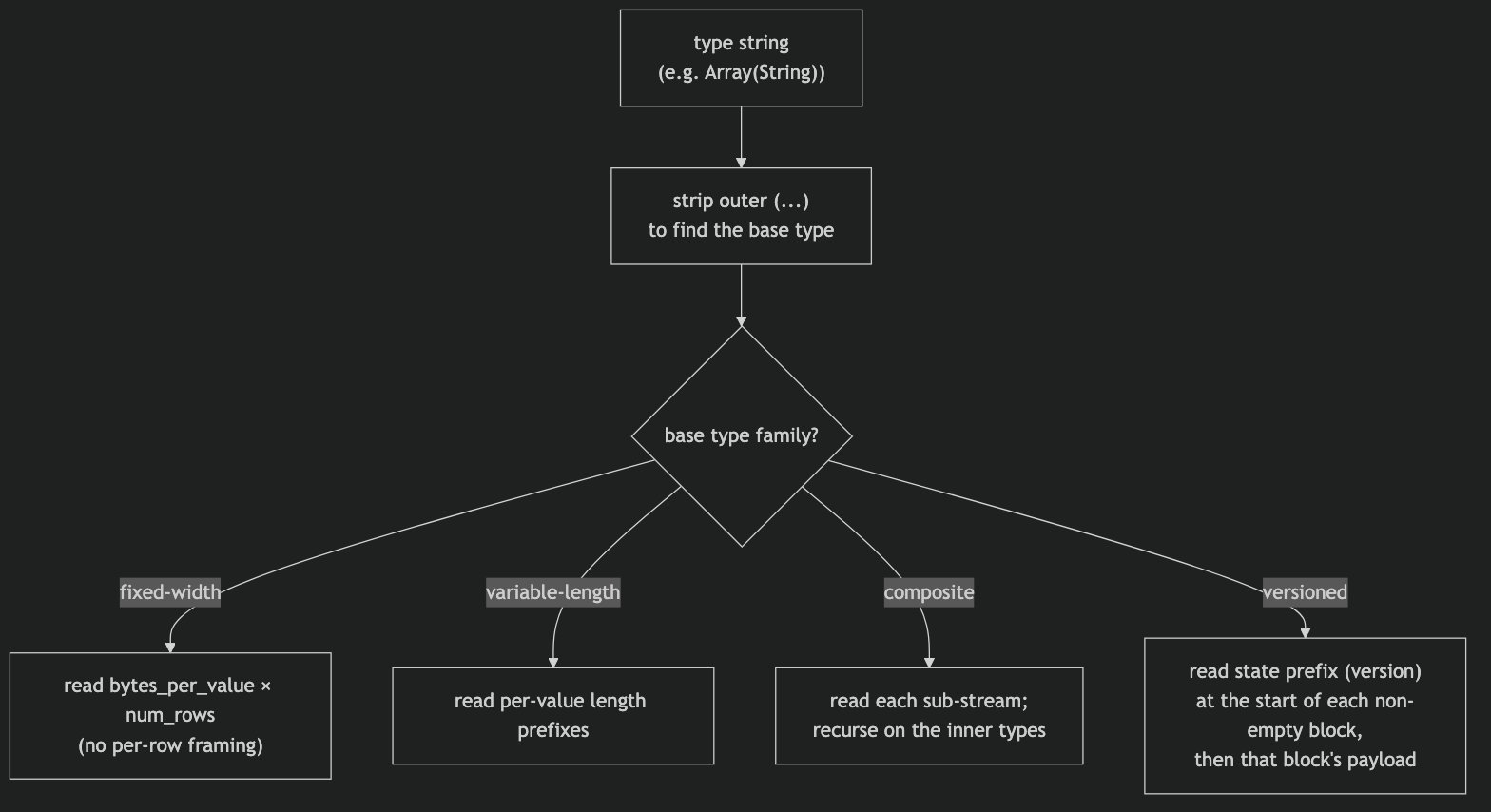
kind_stack and sparse encoding
Thekind_stack byte enumerates a non-default per-column serialization:
COMBINATION payload uses a different enum. The five rows above are compact one-byte codes. COMBINATION (0x05) is the general escape for any stack not covered by them: it is followed by a VarUInt count and then count one-byte entries. Those entries are not the compact codes from the table — they are the raw ISerialization::Kind values:
The byte values differ from the compact codes:
REPLICATED is 0x03 in this nested enum but 0x04 as a compact code, and there is no DETACHED_OVER_SPARSE entry — that combination appears as the two consecutive entries SPARSE, DETACHED. A decoder that keeps using the compact table for the nested bytes will mis-map 0x03/0x04 and desynchronize.
The count is the full stack length including the leading DEFAULT entry that begins every stack. The compact codes already cover every one- and two-entry stack, so a COMBINATION always has a count of at least three.
Kind stack validity. A decoder rejects a malformed stack with INCORRECT_DATA rather than building the serialization it describes:
- the stack starts with
DEFAULT; - the stack is a subsequence of
DEFAULT,SPARSE,REPLICATED,DETACHED— the order in which the kinds wrap each other.SPARSEcan sit insideREPLICATEDbut not the other way round, andDETACHEDis always last because aColumnBLOBholds the serialized form of everything below it. This also means no kind occurs twice, which boundscountby the number of kinds.
ColumnSparse whose values column is itself sparse or replicated, for instance, stays wrapped.
Recursive kind_stack for Tuple columns. The kind_stack payload above is the byte (or COMBINATION sequence) for one column’s own serialization info. A Tuple carries a SerializationInfoTuple, which first writes the tuple’s own kind-stack payload and then writes one full kind-stack payload for each element, in order; a decoder reads back the same recursive structure. So for Tuple(A, B, C) the field-4 bytes are [tuple_kind][A_kind][B_kind][C_kind], and each element payload is itself recursive if that element is again a composite. The has_custom_serialization byte (field 3) is set whenever the tuple’s own info or any element’s info is non-default, so a Tuple whose only special element is sparse or replicated still triggers the kind-stack payload. A decoder that reads only the single leading enum byte for a Tuple will stop too early and misread the remaining element-kind bytes as column data.
Sparse wire format. When kind_stack = 0x01, the column data is two streams written back-to-back in the single shared TCP stream:
- Offset stream — a sequence of
VarUInts. Each valuevis either:vwith the high bit at position 62 clear:(v & 0x3FFFFFFFFFFFFFFF)= the number of default positions before the next explicit non-default value. That non-default position iscursor + group_size, wherecursoris the running position; afterwardscursoradvances bygroup_size + 1.vwith bit 62 set (END_OF_GRANULE_FLAG): the value with the flag cleared = the number of trailing default positions after the last non-default. This marks the end of the offset stream for the block.
- Values stream —
countnon-default values densely encoded in the inner type, wherecountis the number of non-EOG VarUInts read above.
num_rows entries by filling every non-explicit position with the inner type’s default value (0 for integers and floats, "" for String, 0 days for Date, and so on).
A sparse Nullable(T) column is a special case, because the default value of Nullable(T) is NULL. The sparse encoding drops the usual Nullable null-map stream entirely: the offset stream identifies the non-default — that is, non-NULL — positions, the values stream holds only those non-NULL values densely in T, and every non-explicit position reconstructs as NULL. A decoder must therefore not look for a null map in the values stream, and must not fill the gaps with a present 0; it fills them with NULL.
Replicated wire format. When kind_stack = 0x04, the column data is a dictionary: a list of distinct element values plus a per-row index into that list (the same lookup shape as LowCardinality). When the inner type is itself versioned — for example LowCardinality(T) — its state prefix is written first, ahead of the index stream: the replicated serialization delegates the prefix phase to the inner type before writing num_rows. Inners with an empty prefix (the leaf types and the plain composites) contribute no bytes here.
elements[indexes[i]] for each output row i. Composite inner types recurse: the element list is materialized in the inner type, then indexed. Supported inner types include the leaf types, Nullable(T), Array(T), Tuple(...), Map(K, V), Nested(...) (each field expanded like an Array), and LowCardinality(T) (the shared dictionary is kept; only the per-element keys are indexed).
Detached wire format. DETACHED (0x02) and DETACHED_OVER_SPARSE (0x03) do appear over the wire — they are not purely internal. On the TCP path, when compression is enabled and the negotiated revision is at least DBMS_MIN_REVISON_WITH_PARALLEL_BLOCK_MARSHALLING (v54478), the column goes through three steps:
- Each eligible column (non-
const, non-Tuple, in a block with more than one row) is wrapped in aColumnBLOBthat holds the column already marshalled and compressed off the main thread. DETACHEDis appended to the wrapped column’s kind stack.- The column
datais written as aVarUIntblob size followed by exactly that many blob bytes.
{DEFAULT, SPARSE, DETACHED}, which serializes as DETACHED_OVER_SPARSE. A client decoding such a column reads the blob length and bytes, then decompresses the blob to recover the inner column payload (see the ColumnBLOB note under compression).
DETACHED is directional: it may appear only in result blocks sent by a server, and only for a whole top-level column — never as one of the element kinds of a Tuple. Unlike the other kinds, it makes the runtime column a ColumnBLOB instead of the column of the declared type, so a receiver accepts it only when its own pipeline converts the blob back. A server therefore rejects DETACHED in any block a client sends — external table data, scalars and insert data alike — with INCORRECT_DATA.
Block variants
All Data-family packets share the same Block wire format. The variants differ only in their column and row counts:Byte-level examples
All examples in this section are taken from the TCP Data-packet path, so they include theBlockInfo prefix and the has_custom_serialization byte. Over FORMAT Native the same blocks are shorter — the equivalent short form is given where it helps.
An empty block (with BlockInfo), 8 bytes total:
SELECT 1 announces one column named "1" of type UInt8, with zero rows. At protocol ≥ 54454 the has_custom_serialization byte is included:
FORMAT Native (revision 0), the same result block has no BlockInfo and no has_custom_serialization byte — SELECT 1 FORMAT Native is 11 bytes:
FORMAT Native: the output format does not emit empty blocks.)
Protocol revision and the Native format
A Native byte stream is shaped above all by the protocol revision its writer and reader run at. The revision is nowhere in the bytes themselves — there is no revision field on the wire — but it still decides whether several features show up at all. Because of that, a decoder has to know which revision a payload was written at before it can parse it. Since the revision is not in the stream, the reader and writer must settle on it some other way. It is a singleUInt64, and both NativeWriter and NativeReader take it as a constructor argument. The writer calls it client_revision and the reader calls it server_revision, but it is the same number. The newest revision this release knows about is DBMS_TCP_PROTOCOL_VERSION (see src/Core/ProtocolDefines.h).
What the revision gates
Each feature sits behind aDBMS_MIN_REVISION_WITH_* threshold. The writer emits the feature only once its revision reaches the threshold, and the reader looks for it under exactly the same rule, so the two stay in step — get the revision wrong on either side and they desynchronize. The gates that matter for the Native format are:
That makes revision
0 the most conservative encoding for almost everything: the stream carries no BlockInfo, no has_custom_serialization byte, V1 Dynamic/JSON, no aggregate-function version, and a bare DateTime with the timezone parameter dropped. Aggregate-function state versions are the exception at revision 0: there is no peer to derive a version for — the stream is written and read back by whoever produced it (a StripeLog data file, a Set/Join backup, a Native format file) — so the writer keeps a version pinned on the type (spelling it out in the type string as usual) instead of downgrading the state to version 0, and only a type that pins no version is written at version 0.
LowCardinality is the one exception, and an important one. The writer’s check is remove_low_cardinality || (client_revision && client_revision < DBMS_MIN_REVISION_WITH_LOW_CARDINALITY_TYPE). The trick is the leading client_revision &&: when the revision is exactly 0, the whole condition short-circuits to false.
So at revision 0 — the default for FORMAT Native — LowCardinality(T) is not stripped. Its type string and per-block state prefix stay in the stream, and the revision-0 reader reads them straight back. Stripping only kicks in at a non-zero revision below 54405, or when it is forced regardless of revision.
That forcing is the remove_low_cardinality flag. The FORMAT Native output never sets it, but the native TCP path does, when low_cardinality_allow_in_native_format = 0 (default 1). In other words, that setting changes native TCP output but does nothing for FORMAT Native.
The practical takeaway: a default FORMAT Native stream may legitimately contain LowCardinality, so do not treat it as a feature that is absent at revision 0.
Where the revision comes from, depending on how the data travels
The same Native bytes can move over different paths: the native TCP protocol, an HTTP request, or a file on disk. Each path sets the revision its own way. One thing to watch: the read side and the write side are set up separately, so they can end up at different revisions.Native TCP protocol — negotiated, both directions
On the native TCP protocol the revision comes out of the Hello handshake. The client sendsDBMS_TCP_PROTOCOL_VERSION, the server sends its own back, and from then on each side serializes at the revision the other side advertised: the server builds its NativeReader/NativeWriter from client_tcp_protocol_version, while the client uses the server_revision it received. There is no explicit min, but neither side can emit a feature it has not implemented, so each direction is effectively capped by the older of the two peers.
When both peers are the same modern build, the two directions land on the same revision (DBMS_TCP_PROTOCOL_VERSION, see src/Core/ProtocolDefines.h) and every gate is on. That is the common case, but it is not guaranteed. With mixed-version or third-party peers the two directions can sit at different revisions, so the gates have to be read per direction: BlockInfo is present for any non-zero revision, but the rest — has_custom_serialization included — only show up once that direction’s effective revision reaches their thresholds. A peer advertising a revision below 54454, for example, neither sends nor receives the has_custom_serialization byte.
FORMAT Native output — revision 0 by default, raisable over HTTP
The Native output format defaults to revision 0. This covers SELECT ... FORMAT Native over HTTP, INTO OUTFILE ... FORMAT Native, and the Native output clickhouse-client writes; in each case the output factory hands FormatSettings::client_protocol_version straight to the NativeWriter, which governs the BlockInfo / has_custom_serialization framing and the offsets String layout. So an HTTP SELECT ... FORMAT Native with a raised client_protocol_version (≥ 54492) writes the offsets layout, while the default revision 0 keeps the portable per-value layout.
Over HTTP that default is not the end of the story. A client can raise it with the ?client_protocol_version=<n> query parameter, which the HTTP handler treats as a reserved parameter rather than a SQL setting: it lands on the query context, and the format layer copies it into FormatSettings. Set it high enough and the HTTP FORMAT Native output starts including the BlockInfo prefix and the has_custom_serialization byte, just like the TCP path — so do not assume an HTTP FORMAT Native payload is always revision 0.
Because the parameter lands on the whole query context, it reaches every NativeWriter built for that request, not only the result stream. In particular a server-side write such as INSERT INTO FUNCTION file('x.native', 'Native', ...) SELECT ... over HTTP with a raised ?client_protocol_version= writes the file at that revision. This is long-standing behavior (it predates the String offsets serialization and applies to BlockInfo and has_custom_serialization too), and it is asymmetric: the read side (below) is not raised the same way, so such a file does not read back through file(...). Leave client_protocol_version off a request that writes data meant to be read again. INTO OUTFILE and local clickhouse-client output have no such knob and stay at 0.
FORMAT Native input — always revision 0
The Native input format always builds its NativeReader at revision 0. It never expects a BlockInfo prefix, never reads the has_custom_serialization byte, and always assumes default serialization — whether it is parsing the body of an INSERT ... FORMAT Native, reading a Native file, or inferring a schema. ?client_protocol_version=<n> does not raise the input revision (only the output side reads that parameter).
Because the input revision is always 0, the input format always reads the per-value String layout; a stream written with the offsets layout (over the native TCP protocol, or via a raised-client_protocol_version SELECT ... FORMAT Native) is not read back through FORMAT Native input — the same asymmetry as the BlockInfo framing.
Round-trip implications
ForFORMAT Native the default is revision 0 at both ends. Data written by SELECT ... FORMAT Native at revision 0 reads straight back into INSERT ... FORMAT Native with no surprises.
A stream produced at a raised output revision (?client_protocol_version=<n> on the SELECT) carries the BlockInfo and has_custom_serialization framing and the offsets String layout, none of which the input format — always at revision 0 — reads back. So raising client_protocol_version only makes sense for a consumer that speaks the native TCP protocol, not for a FORMAT Native round trip over HTTP.
Files are the asymmetric case. A raised ?client_protocol_version= on a server-side INSERT INTO FUNCTION file(...) (or s3, url) writes the file at that revision, but a file(...) read always parses at revision 0 — so such a file does not round-trip. Either leave client_protocol_version off the writing request so the file is plain revision 0, or move the data over the native TCP protocol, where each direction uses the handshake-negotiated revision.
Protocol revision vs serialization versionDo not confuse the protocol revision with the serialization version. The revision here is connection- or request-wide and never appears in the bytes. The serialization version is per column, carried by versioned types, and is written into every non-empty block. The revision decides whether a feature is there at all; the serialization version, once you are inside a versioned column, picks which variant of that one type’s encoding follows.
Data types
This section documents the wire encoding of the types the Native format can carry within a column’sdata, grouped into four families of increasing decoder complexity. Two types — AggregateFunction(func, ...) and QBit(T, N[, stride]) — are valid Native column types but have function- or type-specific payloads that are out of scope here; they are called out below where they would otherwise be mistaken for aliases.
Fixed-width types
Each value occupies a constant number of bytes. A column ofM rows occupies exactly bytes_per_row × M bytes on the wire, concatenated with no separators or padding.
Integer types
UInt8–UInt256 and Int8–Int256 are direct binary encodings of integer values. A decoder reads bytes_per_row × num_rows bytes and interprets them according to the type.
A UInt32 column holding [1, 256, 65536]:
Int32 column holding [-1, 42]:
Float32 and Float64
Standard IEEE 754 binary floats: 4 bytes single-precision (binary32) and 8 bytes double-precision (binary64), each little-endian. NaN, ±Infinity, ±0.0, and subnormals all round-trip without normalization.
Float32 value 1.5 (0x3FC00000):
Float64 value 1.5 (0x3FF8000000000000):
BFloat16
The brain-floating-point format: the high 16 bits of an IEEE 754Float32 — 1 sign bit, 8 exponent bits, 7 mantissa bits. Each value is 2 bytes, little-endian, holding the raw 16-bit pattern. To recover the numeric value, widen it back to Float32 by placing the pattern in the high half and zeroing the low half (bits << 16 reinterpreted as Float32); the widened value then shares Float32’s text formatting.
BFloat16 value 1.5 (pattern 0x3FC0, the top half of Float32 0x3FC00000):
Bool
Wire-compatible withUInt8: 1 byte per row, 0x00 = false, 0x01 = true. The type string on the wire is literally Bool (not UInt8), so a decoder dispatching on the type string must recognize it separately.
A Bool column [true, false, true]:
Date and Date32
Both encode dates as integer day counts relative to the Unix epoch1970-01-01. Neither carries a time component.
Date value 1970-01-02 (1 day):
Date32 value 1900-01-01 (-25567 days):
DateTime
Wire-compatible withUInt32: a Unix timestamp in seconds, 4 bytes little-endian. The type may appear as DateTime or DateTime('Timezone'); the timezone affects display only and is not part of the wire value. Two DateTime columns with different timezone parameters produce identical bytes for the same instant. A decoder strips the (...) parameter suffix and processes the column as UInt32.
DateTime('UTC') value 2024-03-15 14:30:00 UTC (timestamp 1710513000):
DateTime64(scale[, timezone])
8 bytes, little-endian Int64 representing ticks at scale10^-scale seconds since the Unix epoch. The scale parameter (0–9) lives in the type string and sets the time unit:
The type appears as
DateTime64(s) (implicit server-default timezone) or DateTime64(s, 'TimezoneName') (explicit timezone, display only). Negative values represent ticks before the epoch.
DateTime64(3, 'UTC') value 2024-01-15 12:30:45.123 UTC (1705321845123 ms):
DateTime64(0) value 2024-01-15 12:30:45 UTC (1705321845 s):
Time and Time64(scale)
A clock duration rather than a point in time.Time is a signed second count, 4 bytes little-endian Int32; Time64(scale) is a signed tick count at the given decimal scale (0–9), 8 bytes little-endian Int64 — the same wire shape as DateTime64.
The textual form is [-]HH:MM:SS[.fraction], but unlike DateTime the hour field is not wrapped to a 24-hour day: it is the total hour count and may exceed 23. The displayed magnitude is capped at 999:59:59 (3599999 seconds); a larger magnitude renders with the seconds at the cap and the stored fraction kept as-is, so a tick count of 3700000.25 renders as 999:59:59.250000. CAST saturates the stored value to the largest representable tick at the target scale (999:59:59.999999 for Time64(6)), not to the whole second, whereas arithmetic can still leave an out-of-range tick count in the column that is capped only on display. None of this affects the wire bytes, which are the plain signed integer.
Time value 45296 (12:34:56):
Time64(3) value 45296789 ticks (12:34:56.789):
Time and Time64 are experimental and require allow_experimental_time_time64_type = 1 on the server.Interval
Interval<Unit> — IntervalSecond, IntervalMinute, IntervalHour, IntervalDay, IntervalWeek, IntervalMonth, IntervalQuarter, IntervalYear, IntervalNanosecond, and so on. Every unit shares one wire encoding: the count as a signed 8-byte little-endian Int64. The unit lives only in the type string — it changes neither the wire bytes nor the textual form, which is the bare integer. A single decoder path handles every unit.
IntervalDay value 5:
UUID
16 bytes per value. The wire encoding is not the canonical 16 big-endian bytes — each 8-byte half is byte-reversed independently. The logical model is a 128-bit identifier in canonical text formxxxxxxxx-xxxx-xxxx-xxxx-xxxxxxxxxxxx, where the bytes are conventionally written big-endian. The wire model takes those 16 canonical bytes, splits them into two 8-byte halves, and writes each half little-endian:
- Wire bytes 0..7 = canonical bytes 0..7 reversed.
- Wire bytes 8..15 = canonical bytes 8..15 reversed.
550e8400-e29b-41d4-a716-446655440000:
IPv4 and IPv6
Two related but differently-encoded address types.IPv4 is 4 bytes, encoded as a little-endian UInt32 holding the canonical 32-bit address (the value (a << 24) | (b << 16) | (c << 8) | d from a.b.c.d). The wire bytes are the network-order bytes reversed.
192.168.1.10 (canonical 32-bit value 0xC0A8010A):
IPv6 is 16 bytes, written verbatim in network byte order with no swap — the same byte order as inet_pton(AF_INET6, ...).
2001:db8::1:
u32 for arithmetic and compact range queries, while IPv6 keeps the network-order layout common to most networking APIs.
Enum8 and Enum16
Wire-compatible withInt8 and Int16 respectively: 1 or 2 bytes per row, two’s complement little-endian for the 16-bit variant. The full variant mapping lives in the type string:
(...) parameter suffix and dispatch as Int8 / Int16 — the wire bytes are just the integer index. A client that surfaces the label parses the 'name' = value map out of the type string and keeps it alongside the column: the integer alone does not recover the label. Text-oriented output renders the label (active) rather than the index, single-quoted ('active') when the enum is nested inside a composite. Because the map is not recoverable from the integer column, it must be retained for nested enums such as Array(Enum8(...)) or Map(Enum16(...), V).
An Enum8('active' = 1, 'inactive' = 2) column [active, inactive, active]:
Enum16(...) value 30000:
Decimal(P, S)
A signed integer scaled by a power of 10. The integer’s byte width is implied by the precisionP; the scale S is the negative exponent (the number of digits after the decimal point). Both live in the type string.
The wire encoding is the backing integer in little-endian two’s complement, and the logical decimal value is
wire_integer × 10^(-S).
ClickHouse always emits Decimal(P, S) regardless of how the type was declared. Decimal32(S), Decimal64(S), and so on all normalize to Decimal(P, S) on the wire (with P set to the natural maximum for the width: 9, 18, 38, 76). A decoder that recognizes only Decimal(P, S) covers every spelling the server emits.
Decimal(9, 4) value 123.4567 → backing integer 1234567:
Decimal(18, 1) value -1.5 → backing integer -15:
Decimal(38, 4) value 123.4567 (16 bytes total):
Nothing
TheNothing type carries no values. In practice it appears only as the inner type of Nullable(Nothing) — what the server returns for an expression like SELECT NULL whose only valid value is the absence of one. It is conceptually a unit type.
On the wire it occupies exactly one placeholder byte per row. The server emits the ASCII character '0' (0x30), but the deserializer ignores the bytes — the content is undefined and decoders must not rely on any specific value. The number of bytes written is num_rows × 1, so the column header’s num_rows fully determines how much to consume.
The byte-per-row keeps the Block invariant intact: every column spans a length derivable from num_rows, so decoders scan forward without per-cell length prefixes. The surrounding Nullable always reports every position as NULL, so the placeholders are never inspected.
A Nullable(Nothing) column with 3 rows (all NULL):
Nullable framing (see Nullable); the inner three bytes are the Nothing payload, which the decoder skips.
Variable-length types
Each value carries its own length on the wire.String
Type string:String. A String column has two wire layouts, selected by the protocol revision (see What the revision gates). The revision is the negotiated revision on the native TCP protocol, and client_protocol_version for FORMAT Native output (default 0); FORMAT Native input is always revision 0, and the Buffers format always uses the per-value layout.
Per-value layout — below DBMS_MIN_REVISION_WITH_STRING_WITH_SIZE_STREAM_SERIALIZATION (54492), which includes the revision-0 default of FORMAT Native: a sequence of num_rows length-prefixed byte sequences:
0x00 byte. The total bytes consumed by the column is Σ (varuint_size(len_i) + len_i) over all rows.
A column of 3 strings ["ab", "", "c"] (6 bytes total):
54492 and above: two concatenated streams, the cumulative byte offsets first, then all data:
Array sends its offsets over the native protocol. Offset i is the end position of value i in the data blob, so the size of value i is offset[i] - offset[i-1] (with offset[-1] = 0) and the last offset is the total size of the data blob. A decoder reads 8 × num_rows bytes of offsets and then reads the whole data blob in one piece, using the last offset as its exact length — which permits exact buffer preallocation and bulk copying instead of per-row parsing, and needs no size-to-offset conversion. A column with num_rows = 0 contributes no bytes in either stream.
The same 3 strings ["ab", "", "c"] (27 bytes total):
String in the block, including String nested inside composite types (Array(String), Nullable(String), Map, Tuple, Variant, Dynamic, JSON) — with one exception: the dictionary of a LowCardinality column is always written with the default nested serialization, so its String values keep the per-value layout at every revision. This covers LowCardinality(String), LowCardinality(Nullable(String)), and any other String-bearing LowCardinality dictionary.
In both layouts ClickHouse String is byte-oriented rather than text-oriented: UTF-8 validity is not enforced, and a value may contain any bytes including embedded NUL. A decoder that targets a UTF-8 string type either validates on read or exposes raw bytes to the caller.
FixedString(N)
Type string:FixedString(N), where N is a positive integer (for example, FixedString(16)). The column is exactly N × num_rows raw bytes, with no length prefixes and no separators. A decoder parses N from the type string and consumes that many bytes per row.
When the SQL inserts a value shorter than N bytes (for example, CAST('abc' AS FixedString(5))), the server right-pads with NUL bytes (0x00) to the declared length. These padding bytes are part of the stored value and are sent on the wire as-is; trimming is a client-side concern. Like String, FixedString(N) is byte-array-like rather than text-like — typically used for fixed-width identifiers, address bytes, or hash digests.
Two FixedString(3) values ["abc", "de\0"] (6 bytes total):
Composite types
Composite types wrap one or more inner types and share a common wire model: multiple streams per column. A single logical column is encoded as two or more independently-read byte sequences, concatenated. They share three structural properties:- Fixed shape per schema. The structure is determined entirely by the type string at decode time.
Array(UInt32)always has the same stream layout, block to block. - No version prefix of their own. The composite wrapper itself adds no version byte; its framing (offsets, null-map, element streams) is stable across ClickHouse releases. This applies to the wrapper only — see the prefix-phase note below for inner versioned types.
- No cross-block state of their own. The wrapper’s framing is fully self-describing per block; any cross-block-state concern comes from an inner versioned type, not the wrapper.
SerializationArray runs its inner type’s prefix phase before the array offsets are written, and Tuple, Map, Nested, and Nullable do the same through their element serializations (Nullable runs the inner prefix before its null map).
So when a composite wraps a versioned/stateful type (LowCardinality, Variant, Dynamic, JSON), that inner type’s version/state prefix is emitted first, ahead of the wrapper’s offsets and element payload. For example, Array(LowCardinality(String)) is laid out as [LowCardinality state prefix] → [array offsets] → [flattened LowCardinality element payload], not offsets-first.
A decoder that reads offsets before running the inner prefix phase will desynchronize on any composite containing LowCardinality, Variant, Dynamic, or JSON. When every inner type is a plain leaf or another non-versioned composite, the prefix phase emits no bytes and the offsets-first description below applies verbatim.
Nullable(T)
Type string:Nullable(InnerType). Examples: Nullable(UInt32), Nullable(String), Nullable(FixedString(16)), Nullable(DateTime('UTC')).
Like the other composites, Nullable delegates the prefix phase to its inner serialization before writing the null map: when the inner is versioned, the inner’s state prefix is emitted first. So Nullable(Tuple(LowCardinality(String))) starts with the LowCardinality state prefix, not the null map. When the inner is a leaf or another non-versioned type, the prefix phase emits no bytes.
The wire layout is the inner prefix phase (empty unless the inner is versioned) followed by two concatenated streams, null-map first:
num_rows bytes, one per row:
The values stream contains the inner type’s standard encoding for all
num_rows rows, including the null positions. A decoder must still read the placeholder bytes at null positions to advance the stream, but must consult the null-map before interpreting any individual value. Senders may write any bytes at null positions, so decoders must not rely on a specific placeholder value.
Placeholder values by inner type family:
Nullable(T) may appear inside Array, Tuple, Map, and Nested — Array(Nullable(T)) and Tuple(Nullable(T1), T2) are common. Nullability does not compose with itself: Nullable(Nullable(T)) is rejected by the server.
A Nullable(UInt8) with three rows [5, NULL, 9] (6 bytes total):
Nullable(String) with three rows ["hello", NULL, "world"] (15 bytes total):
Array(T)
Type string:Array(InnerType). Examples: Array(UInt32), Array(String), Array(Nullable(UInt32)), Array(Array(UInt8)).
The wire layout is the inner prefix phase (empty unless the inner type is versioned) followed by two concatenated streams, offsets first:
num_rows little-endian UInt64 values, each the cumulative end position in the values stream after that row’s elements:
- Element start index for row
N=offsets[N - 1](or0whenN == 0). - Element end index (exclusive) for row
N=offsets[N]. - Row
N’s element count =offsets[N] - offsets[N - 1].
offsets[num_rows - 1] is therefore the total element count across all rows, and the values stream holds that many inner values concatenated end-to-end.
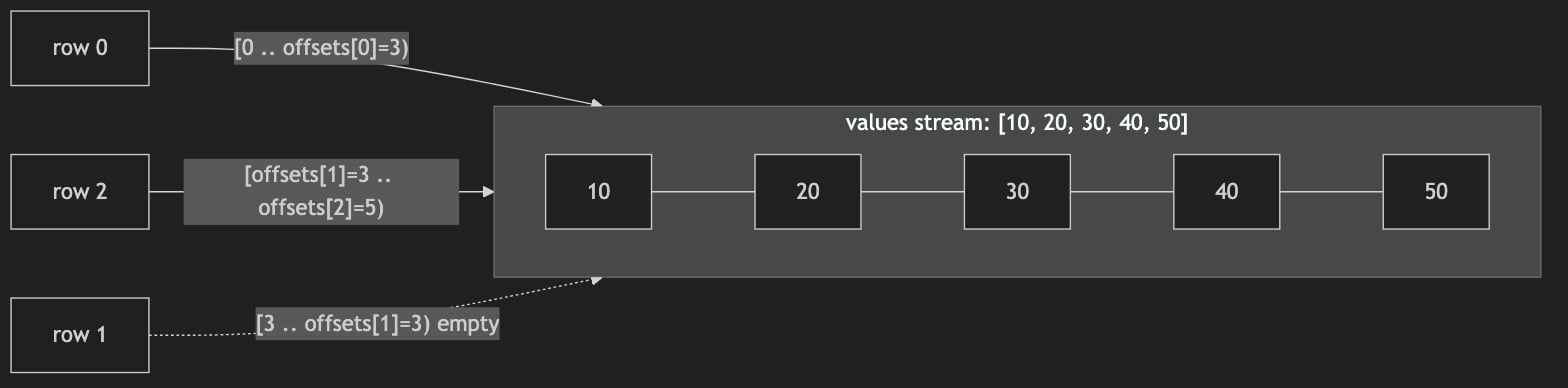
Offsets are monotonic non-decreasing; equal consecutive offsets mean an empty row, and a decoder should reject non-monotonic offsets as corruption. An empty column (num_rows == 0) writes zero bytes — no offsets stream and no values stream. Inner types may be any type, including other composites: Array(Array(T)), Array(Tuple(...)), and Array(Nullable(T)) are all legal.
Array(UInt32) with rows [[10, 20, 30], [], [40, 50]] (44 bytes total):
0 for row 0). Equal consecutive offsets are an empty row:
Array(String) with rows [["a", "bb"], []] (20 bytes total):
Array(Array(UInt32)) with rows [[[1,2]], [], [[3], [4,5]]] nests the same shape:
- Outer offsets:
[1, 1, 3]— row 0 has 1 inner array, row 1 has 0, row 2 has 2. - The middle
Array(UInt32)decodes 3 rows with offsets[2, 3, 5]. - The innermost
UInt32decodes 5 values:[1, 2, 3, 4, 5].
Tuple(T1, T2, …)
Type string:Tuple(T1, T2, ..., Tn). Examples: Tuple(UInt32, String), Tuple(Int32), Tuple(Array(UInt32), String), Tuple(UInt8, Tuple(Int32, String)). ClickHouse also supports named tuples via Tuple(a UInt32, b String); names are metadata only and do not affect the wire format.
The wire layout is the elements’ prefix phase (each versioned element contributes its state prefix, in declaration order; empty for non-versioned elements) followed by N concatenated streams, one per element type, in declaration order:
num_rows values. There is no length prefix, no offsets stream, and no separators between streams. An empty column (num_rows == 0) writes zero bytes per stream. Element types may be any type, including other composites — Tuple(Tuple(...), ...), Tuple(Array(...), ...), and Tuple(Nullable(T1), T2) are all legal.
The zero-element tuple Tuple() is also legal — it arises from expressions like SELECT tuple() or CAST(x AS Tuple()). Having no element streams, it instead serializes like Nothing: one placeholder byte (0x30, ASCII '0') per row, which the deserializer discards. The row count comes from the block header, exactly as for Nothing.
Tuple(UInt8, UInt8) with 3 rows (1,4), (2,5), (3,6):
[1, 2, 3] for element 0 and [4, 5, 6] for element 1.
Tuple(UInt32, String) with 2 rows (10, "a"), (20, "bb") (13 bytes total):
Map(K, V)
Type string:Map(KeyType, ValueType). Examples: Map(String, UInt32), Map(String, Array(UInt32)), Map(UInt8, Tuple(Int32, String)), Map(Array(String), Int8). The wire format places no restriction on either type — both K and V may be any supported type, including composites. (ClickHouse’s SQL-level rules around accepted key types have varied across releases; consult the SQL documentation for the targeted server version.)
The wire layout is byte-identical to Array(Tuple(K, V)), so it begins with the inner prefix phase (empty unless K or V is versioned):
total_pairs = offsets[num_rows - 1] (or 0 when num_rows == 0). The offsets stream has the same semantics as Array. Keys are positionally aligned with values: pair i is (keys[i], values[i]).
ClickHouse’s in-memory representation of a Map column is an array of tuples; the type system surfaces it as a distinct type for SQL ergonomics (m['key'], mapKeys, mapValues). The wire format is a direct serialization of that storage, so Map and Array(Tuple(K, V)) are byte-for-byte interchangeable.
Offsets are monotonic non-decreasing, and both the keys and values streams contain exactly total_pairs values. An empty column writes zero bytes. Within a single row keys are typically unique, but this is a semantic rule, not a wire-enforced one: the wire format lets duplicate keys round-trip, and server-side semantics resolve duplicates only when a Map-aware function consumes the row.
Map(UInt8, UInt8) with 2 rows {1:10, 2:20}, {3:30} (22 bytes total):
i is reconstructed by reading keys[i] and values[i] together.
Map(String, UInt32) with 1 row {'a':1, 'b':2} (20 bytes total):
Nested(name1 T1, name2 T2, …)
The on-wire representation ofNested depends on the server-side flatten_nested setting, which gives two distinct cases.
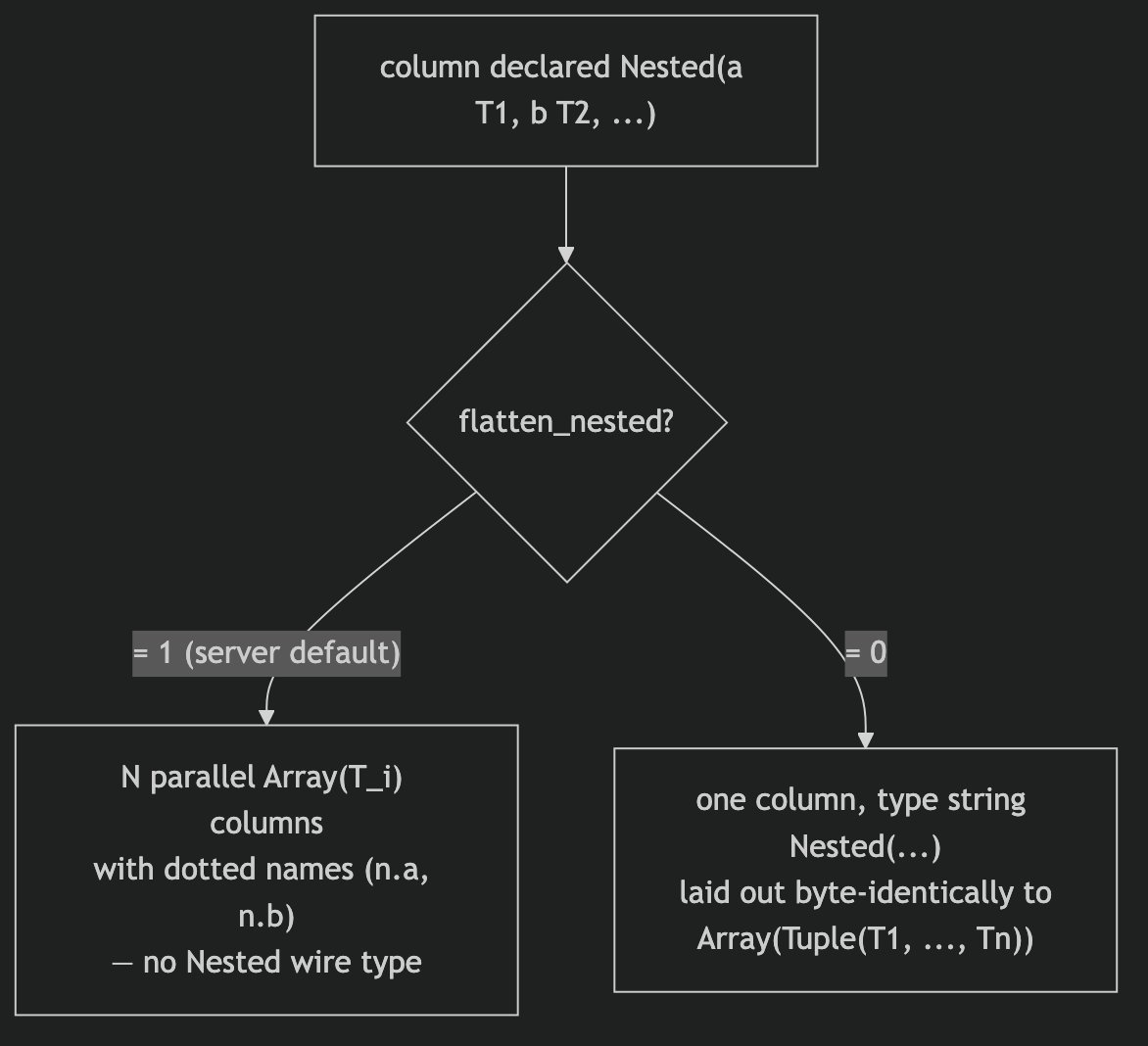
flatten_nested = 1 (server default). When the table was created under default settings, Nested is not a wire type. The server stores and presents the column as N parallel Array(T_i) columns with dotted names (outer.field1, outer.field2, and so on). For the format layer there is nothing new — every dotted column is a regular Array:
flatten_nested = 0. When the table was created with flatten_nested = 0, the column appears on the wire as a single column with type string Nested(name1 T1, name2 T2, ...), and its layout after the type string is byte-identical to Array(Tuple(T1, T2, ..., Tn)) — including the inner prefix phase, so any versioned field T_i emits its state prefix first, ahead of the offsets. The example below uses non-versioned fields, so the prefix phase is empty:
Nested preserves the field names (a, b), which Array(Tuple) does not carry as named slots.
The Case B type string is a comma-separated list of (name, type) pairs. The first whitespace separates a name from its type; the type itself may contain further whitespace, commas, and parens, so parsing needs the same depth-aware splitter used for Tuple. The wire layout:
total_elements = offsets[num_rows - 1] (or 0 when num_rows == 0). Offsets are monotonic non-decreasing, and every field stream holds exactly total_elements values. The server enforces at INSERT time that, within a single row, all fields carry the same number of elements. An empty column writes zero bytes.
Nested(a UInt8, b String) with 2 rows [(10,'x'),(20,'y')] and [(30,'z')] (25 bytes after the type string):
Type aliases
Several types are pure aliases: the server sends the alias name in the column header, but the bytes that follow are those of an underlying type. A decoder maps the alias to that type and reuses its codec — no new wire format is involved. The geographic types alias to nested arrays and tuples:
So a
Point column is decoded exactly as Tuple(Float64, Float64) (rendering as (1,2)), a Ring as Array(Tuple(Float64, Float64)) ([(0,0),(1,1)]), and so on up the hierarchy.
Geometry is also an alias, but to a Variant rather than a nested array: its payload is the variant of the seven geo types above. The column header carries just the type string Geometry — it does not spell out the variant — so a decoder must expand it itself. Unlike a user-spelled Variant, the discriminators of Geometry do not follow the name-sorted order: they are fixed for compatibility, and new geo types are only ever appended. The mapping is 0 = LineString, 1 = MultiLineString, 2 = MultiPolygon, 3 = Point, 4 = Polygon, 5 = Ring, 6 = MultiPoint (added in 26.7 — streams from older servers simply never contain discriminator 6). Each selected value is then decoded through its geo alias above (NULL uses the Variant NULL discriminator 255).
SimpleAggregateFunction(func, T) is an alias for its value type T. It stores an already-finalized aggregate value, so its wire form and rendering are exactly those of T (SimpleAggregateFunction(sum, UInt64) is decoded as UInt64). Only the single-value-type form is an alias this way; the underlying type may itself be a composite.
Two related types are not aliases. They are valid
Native column types — a client can receive an AggregateFunction column from a -State combinator or distributed aggregation, for instance — but each carries its own specialized payload that is outside the scope of this page:AggregateFunction(func, ...)holds an intermediate aggregation state (not a finalized value); its binary layout is specific to the aggregate function and version. The function name may carry parameters, each printed as a SQL literal, as inAggregateFunction(topK(3), UInt64). A parameter whose value has no unambiguous bare literal form, that is aDecimal, a wide integer, aUUID, anIPv4/IPv6, or a non-negativeInt64, is printed with an explicit::Typesuffix, as inAggregateFunction(topK('3'::Decimal32(0)), UInt64), and inside an array or tuple parameter the suffix goes on the elements, so a decoder that inspects parameters must accept both spellings. A decoder that only needs the argument types is unaffected. A versioned aggregate function spells a non-zero state version out as the first argument of the type string —AggregateFunction(1, quantileDeterministic, UInt64, UInt64)— while version0is not printed, so the type string staysAggregateFunction(quantileDeterministic, UInt64, UInt64). On a negotiated connection (revision above0) the writer picks the version from the protocol revision alone — never from a version that happens to be pinned on its local type, because version0is indistinguishable on the wire from “no version announced” — so the same function can announce different versions on different connections, and a reader must take the version from the type string rather than assume the newest one. At revision0there is no peer to derive a version for — the stream is self-describing and read back by whoever wrote it — so a version pinned on the type survives into the stream (and into the announced type string) rather than being downgraded to0.quantileDeterministic(with thequantilesDeterministicandmedianDeterministicspellings) is versioned from revision54491: version1appends a trailingUInt8 skip_degreeto the state, and its prefix is byte-identical to version0. Below that revision the writer emits version0states, so an older peer is unaffected.uniqis versioned from revision54493: version1prepends a flags byte to the version-0layout and, when bit0of the flags is set, appends a small additional sample of full 64-bit hashes, each XOR-ed with the constant0x9E3779B97F4A0000(UInt8 skip_degree,VarUInt count, then the 8-byte values), which keeps the estimate accurate at cardinalities above two billion; a version0state carries the 32-bit main sample only. Bit1of the flags says that the 64-bit sample is incomplete — the state has absorbed a version0state, whose elements were never offered to a 64-bit sample — in which case no 64-bit sample is written and a reader must estimate from the 32-bit main sample alone (and keep saying so in the states it goes on to write); the two bits are therefore mutually exclusive, and a reader must reject a state that sets both. No other bit is defined, and a reader must reject a state that sets one. All of this applies equally to a state nested inside a container type —Array,Tuple,Map,Nullable,Variant(where the alternative’s spelled-out version changes the type string without changing the discriminator order), or aNested/SimpleAggregateFunctionwrapper. It also applies under aggregate-function combinators: a pass-through combinator over a versioned function —uniqIf,uniqArray,uniqForEach,uniqMap,uniqArgMin/uniqArgMax,uniqOrNull/uniqOrDefault,uniqResample, and the implicitNullable-argument adaptor — forwards the version to the nested states its payload contains, spells the nested function’s current version out in a fresh state’s type string exactly like the plain function (AggregateFunction(1, uniqIf, UInt64, UInt8)), and derives the version from the protocol revision on a negotiated connection the same way. A wrapper’s custom name contains a second copy of its argument type, so the writer must rebuild that copy with the same negotiated aggregate-state version; otherwise its header can announce version1for a version-0payload. OneVariantcorner case has no wire representation at all: when two alternatives differ only in a spelled-out state version (legal as a column type, since the type strings differ), re-versioning both for the negotiated revision would collapse them into the same alternative, so the sender must fail the transfer rather than announce versions the payload is not written with.Dynamicis the deliberate exception to revision-derived versioning: aDynamiccolumn announces its nested types itself — through its own type lists and through the binary type encoding, whose explicit version field carries a spelled-out state version (the values of its shared variant embed their type that way even at rest) — and those announcements are part of the column’s own data, identical for every peer and every medium, so they are never rewritten for a negotiated revision. A state nested inside aDynamicvalue is therefore written at the version spelled in its type (which a fresh state carries, since a-Statequery result spells its version out), and at version0when the type spells none, on every connection and medium alike.QBit(T, N[, stride])stores a vector with its bit planes transposed for vector-search workloads; its on-wire stream layout (group-majorFixedStringbit-plane streams,element_size * (N / stride)of them with an explicitstride) and its binary type encoding (tag0x36, or0x37QBitWithStridewhenstride != N) are documented on theQBitdata type page and in the binary type encoding reference, so aNativereader does not have to recover them from the C++ source.
Versioned types
Versioned types carry an on-wire serialization-version prefix that declares which variant of the encoding follows. They may also use multiple streams (like the composites). On theNative wire the prefix and any dictionary are per block — these types maintain no cross-block state (see the per-block prefix note below); cross-block serialization state exists only in the MergeTree on-disk stream.
These types are considerably more involved than the fixed-shape composites, and a client targeting simple analytical queries can defer them.
Serialization version: concept
A serialization version is a per-type, per-column on-wire version number that declares which variant of a type’s encoding the sender is using. It is the first thing in the column’s state prefix, so the decoder reads it and dispatches to the right parser for the rest of the column. It is distinct from the protocol version:
Most versioned types write the version as a little-endian UInt64 immediately before any other state-prefix data; a few use VarUInt or UInt8. A decoder reads the version first and rejects unknown values — a higher version implies a newer sender format the decoder does not understand, and mis-parsing it corrupts every subsequent byte.
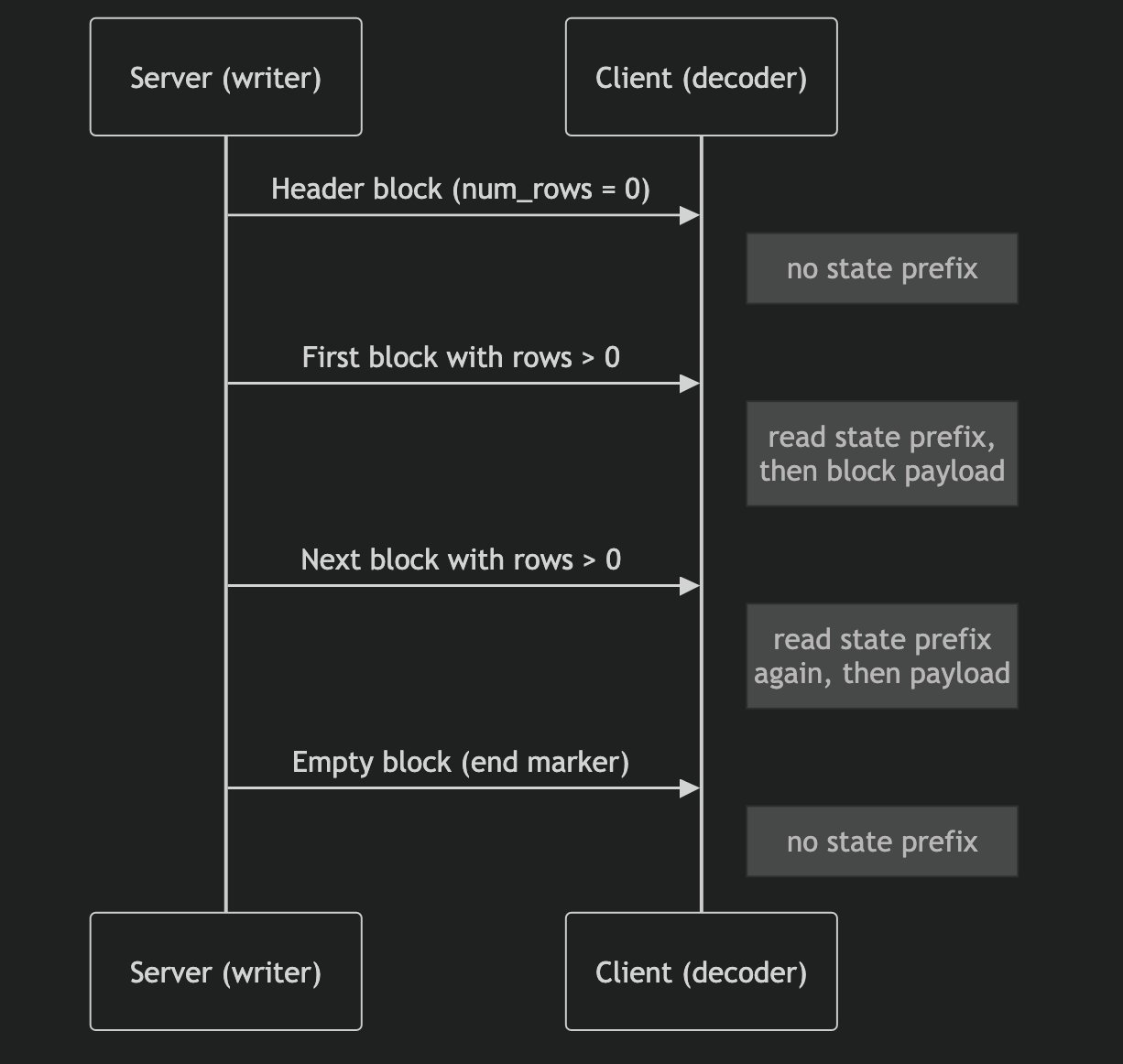
The state prefix is emitted at the start of every block whose row count is greater than zero, immediately before that block’s payload.
The Native writer and reader do not keep serialization state across blocks:
NativeWriter creates a fresh serialize state and writes a state prefix for each non-empty column block it writes, and NativeReader creates a fresh deserialize state and reads it for each non-empty block it reads (both skip the prefix entirely when rows == 0).
Header blocks (rows = 0) and empty blocks therefore emit nothing, and a decoder must read the state prefix again at the start of each non-empty block. A decoder that reads the prefix only once and treats later blocks as payload-only will read the next block’s prefix as data and desynchronize:
Serialization version reference
A few things worth noting about the table:
- The values are not contiguous.
Dynamicuses1,2,3,4withV3at4andFLATTENEDat3. A higher number is not necessarily newer. - Some values are native-format-only.
Object::STRING,Object::FLATTENED, andDynamic::FLATTENEDexist for native-protocol compatibility with clients that do not implement full Object/Dynamic. They do not appear in MergeTree on-disk storage. V3is on-disk only.Object::V3andDynamic::V3are listed because the values are assigned and must not be reused, not because a decoder can meet them: ClickHouse never sends them overNativeand rejects them there withINCORRECT_DATA. Everything they carry — the shared-data sub-version ofObject::V3and its bucket and granule layouts — describes a part rather than a block, and is therefore out of scope for this page. Clients consuming the native TCP protocol seeV1,V2,STRINGorFLATTENED.
LowCardinality(T)
The simplest versioned type. It replaces a column ofN inner values with a small dictionary of unique values plus N indices into that dictionary.
Type string: LowCardinality(InnerType). Examples: LowCardinality(String), LowCardinality(FixedString(4)), LowCardinality(Nullable(String)).
sharedDictionariesWithAdditionalKeys; other values are reserved.
The per-block metadata UInt64 is a bitfield:
For a typical query response with a single data block per column, the metadata is
0x600 (HasAdditionalKeys + NeedUpdateDictionary).
The dict values are dict_size values encoded using the inner type T. The dictionary reserves leading slots for special values: a non-nullable column reserves one (dict[0] holds the inner type’s default value, e.g. "" for String), and real distinct values start at dict[1].
For LowCardinality(Nullable(T)) the dict is still encoded as plain T (no null-map stream), but two slots are reserved: dict[0] is the NULL marker and dict[1] is the inner type’s default value (e.g. "" for String); real distinct values start at dict[2]. A NULL row’s key points at dict[0], and that slot is written on the wire as the inner type’s default bytes.
The keys are indices into the dict; each index is 1 << key_type_code bytes (1, 2, 4, or 8), and value N is reconstructed as dict[keys[N]].
keys_count is the number of LowCardinality values at the current recursive level, not necessarily the block’s row count. For a top-level LowCardinality column the two coincide. But when the LowCardinality sits under a composite, the count is the flattened value count that the composite passes down: for Array(LowCardinality(String)) with three rows holding five elements in total, keys_count is 5, not 3; for Map(K, LowCardinality(V)) it is the total pair count, and so on. A decoder must take keys_count from this field rather than assuming the block row count. When that flattened count is zero — for example a block whose arrays are all empty — the LowCardinality data phase writes nothing at all: only the state prefix (emitted in the composite prefix phase) is present, with no metadata, dictionary, or keys_count following.
The state prefix is read at the start of every block whose row count is greater than zero — header blocks (rows = 0) and empty blocks emit nothing. Within a block, keys_count equals the row count, dict_size equals the number of values in the dict stream, and each key fits in 1 << key_type_code bytes.
In the
Native format each block ships a self-contained, block-local dictionary — there is no cross-block dictionary state. The Native writer sets low_cardinality_max_dictionary_size = 0, so SerializationLowCardinality never builds a shared dictionary: every non-empty block writes its keys as block-local additional keys with NeedGlobalDictionaryBit unset (metadata 0x600), and the Native reader rejects NeedGlobalDictionaryBit when native_format is true. A decoder must therefore reset the dictionary at each block and read the dict_size entries present in that block; carrying a dictionary over from a previous block would misread the next block’s keys. (Persisting an LC dictionary across blocks is a MergeTree on-disk concern, not the Native wire layout.)LowCardinality(String) with values ['a', 'b', 'a', 'c', 'b']:
dict[1], dict[2], dict[1], dict[3], dict[2] = ["a", "b", "a", "c", "b"].
LowCardinality(Nullable(String)) with values ['a', NULL, '', 'b'] shows both reserved slots — dict[0] for NULL and dict[1] for the empty-string default:
dict[2] = "a", dict[0] = NULL, dict[1] = "", dict[3] = "b", i.e. ["a", NULL, "", "b"]. Both dict[0] and dict[1] are empty bytes on the wire; the null-ness comes from the key pointing at slot 0, not from the bytes.
JSON (Tier 1: String fallback)
ClickHouse’sJSON type has several wire encodings (see the serialization version reference). Tier 1 is the simplest: when the per-query setting output_format_native_write_json_as_string = 1 is set, the server flattens every JSON value to its serialized text and emits the column as a String with a state-prefix marker.
Type string: JSON.
1 for this String fallback. The other values denote different JSON/Object encodings: 0 = V1, 2 = V2 (the default over the native TCP protocol), 3 = FLATTENED, 4 = V3 (see the serialization version reference). A decoder that sees a value other than 1 here is not looking at the String fallback. The prefix is read at the start of every block with rows > 0, and the values stream is a standard String column for num_rows rows.
JSON value '{"a":1}' (one row):
{"a":1}, with the integer left as an integer. The text is just a String value, so the client receives the JSON for opaque transit but does not recover the individual paths and their ClickHouse types; faithful per-path typing requires the Tier 2 encoding below.
Variant(T1, T2, …)
A discriminated union: each row holds a value of exactly one of the variant types, or NULL. Every row carries a one-byte global discriminator selecting its type, and the per-type values are then stored densely, one contiguous run per variant type. Type string:Variant(T1, T2, ...). The server canonicalizes the order (variant types are sorted by name), so the type string as received already lists the types in global-discriminator order: discriminator 0 selects the first listed type, 1 the second, and so on. 255 (NULL_DISCRIMINATOR) means the row is NULL. Variant elements are never Nullable — NULL is the discriminator’s job. Examples: Variant(String, UInt64), Variant(Array(UInt8), String).
The state prefix carries a UInt64 LE discriminators mode: 0 = BASIC (every row’s discriminator written literally), 1 = COMPACT (run-length granule encoding). The server uses BASIC over the native protocol by default (use_compact_variant_discriminators_serialization = false); only BASIC is specified here.
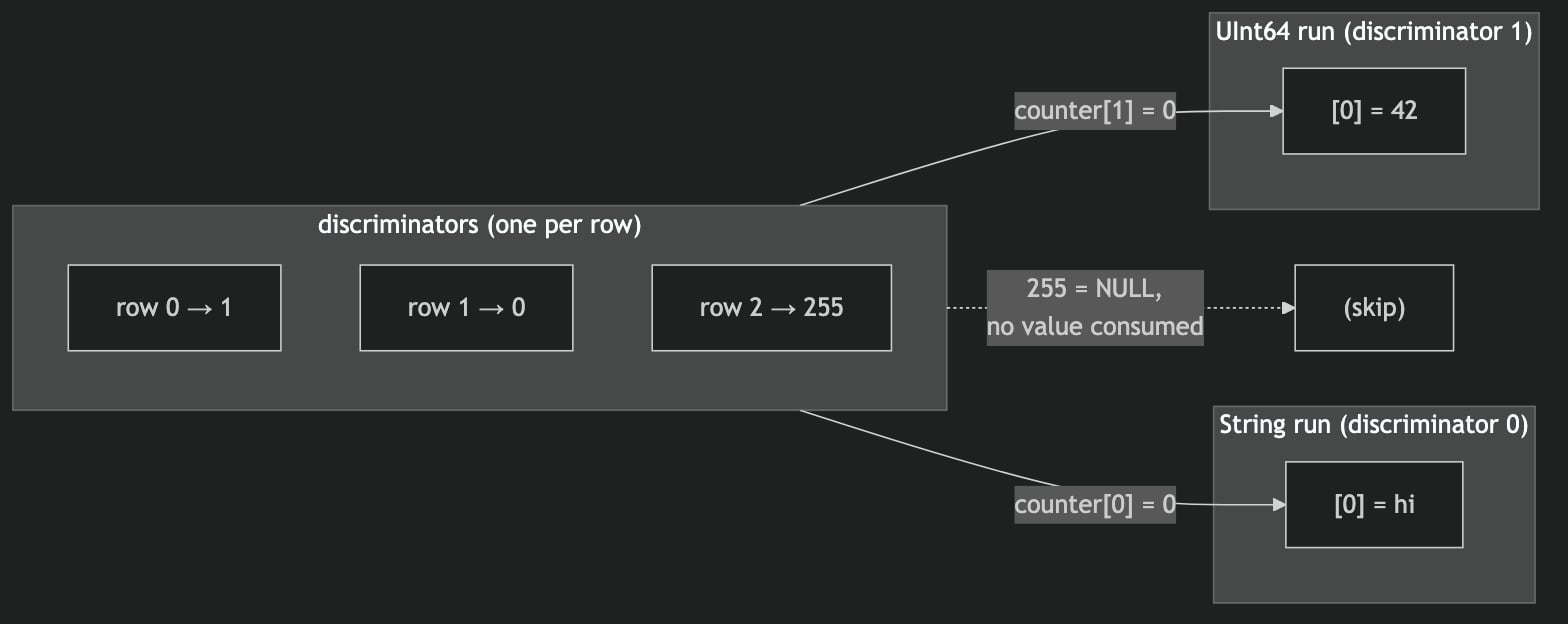
r with discriminator d (≠ 255) takes the value at index counter[d] from variant type d’s value run, then counter[d] is incremented. Rows with discriminator 255 are NULL and consume no value from any run, so the sum of the per-type counters equals the number of non-NULL rows.
The state prefix (the mode UInt64) is read at the start of every block with rows > 0; header and empty blocks emit nothing. Each non-NULL discriminator is less than the number of variant types, and variant type i is decoded for exactly count[i] rows.
Variant elements that are themselves stateful (
LowCardinality, Variant, Dynamic, JSON) emit their own state prefix in the per-element state-prefix phase, after the mode UInt64. Leaf types and the plain composites (Array, Tuple, Map of leaf types) have empty state prefixes and compose freely.Variant(String, UInt64) with values [42, 'hi', NULL] (canonical order sorts String before UInt64, so discriminator 0 = String, 1 = UInt64):
42; row 1 = String run[0] = "hi"; row 2 = NULL.
The discriminator stream is the index; each non-NULL discriminator pulls the next value from its type’s dense run, while 255 (NULL) consumes nothing. This same walk reconstructs Dynamic, which differs only in how NULL is encoded:
Dynamic
A column whose value type is discovered at runtime: each row holds a value of one of a runtime-determined set of types, or NULL. UnlikeVariant, the type set is not in the column’s type string — it is carried in the state prefix.
Type string: Dynamic or Dynamic(max_types=N). The max_types parameter bounds how many distinct types the column tracks but does not affect the wire format below.
Dynamic has four encodings — V1 = 1, V2 = 2, FLATTENED = 3, V3 = 4. Which one the server emits depends on the channel and on the query settings:
- Over
clickhouse-clientand HTTPFORMAT Nativethe writer’s revision is0(unless raised withclient_protocol_version), so the default is V1. - Over the native TCP protocol at its negotiated revision the default is V2. The
Nativewriter leaves statistics disabled, so a defaultV2payload carries no per-variant statistics — after the type list come the nestedVariantprefix and data directly. (Per-variant statistics are a MergeTree on-disk concern, not part of the Native wire.) - The query setting
output_format_native_use_flattened_dynamic_and_json_serialization = 1overrides both and emits FLATTENED (version 3) regardless of revision.
ScopeThis page specifies only the
FLATTENED layout. The non-flat V1/V2/V3 binary layouts are the internal/on-disk representation (binary-encoded type lists, per-variant statistics) and are not specified here. A client that wants to decode Dynamic using this page must request FLATTENED by setting output_format_native_use_flattened_dynamic_and_json_serialization = 1; the layout below assumes that setting. Because the version byte heads the prefix, a decoder can detect the actual encoding it received and reject V1/V2/V3 if it only implements FLATTENED.num_types types plus the NULL slot — UInt8 for num_types ≤ 255, then UInt16, UInt32, UInt64. NULL is the discriminator value num_types itself, which differs from Variant, where NULL is the fixed value 255. Reconstruction is the same dense walk as Variant: keep a per-type counter, and row r with discriminator d (≠ num_types) takes value counter[d] from type d’s run.
The state prefix (version + type list) is read at the start of every block with rows > 0; header and empty blocks emit nothing.
Malformed counts
num_types is read from the stream before any type names. A decoder must treat it as untrusted and must not use it to size an allocation directly — neither a count close to SIZE_MAX (which can overflow intermediate arithmetic or throw a non-DB::Exception) nor a large-but-representable count such as 100000000 (which is far below a vector’s max_size() yet would allocate gigabytes before a single type name is read). ClickHouse reads the type list one entry at a time with only a capped pre-allocation hint, so a corrupted num_types is rejected either as INCORRECT_DATA (“Dynamic column has too many types”, when the count exceeds what the container can hold) or as an ordinary read error once the stream runs out of type entries — never as an out-of-memory failure.Do not, however, bound the flattened num_types by ColumnDynamic::MAX_DYNAMIC_TYPES_LIMIT (254 in ClickHouse): the flattened type list carries every distinct runtime type, including those that had overflowed into the shared variant, so a valid flattened block can legitimately list far more than that. The MAX_DYNAMIC_TYPES_LIMIT bound applies only to the num_dynamic_types count in the non-flat V1/V2/V3 prefixes, which counts regular-variant slots and is capped by the limit (ClickHouse validates it there before the + 1 for the shared variant).Truncated streamsThe discriminator run holds exactly
num_rows entries, and a decoder must verify that it read that many rather than accepting whatever the stream contained. A shorter run does not contradict anything that follows it: the per-type value counts are derived from the discriminators actually read, so they stay consistent with the value runs, and a run made entirely of NULL markers demands no value bytes at all. ClickHouse rejects a short discriminator run with INCORRECT_DATA (“Mismatch in flattened Dynamic column: N rows are expected, but the indexes stream contains only M rows”) before any per-type check, because the reconstructed column is then used for num_rows rows regardless of its actual size.Runtime types whose serialization is stateful (
LowCardinality, Variant, Dynamic, JSON) carry nested state prefixes after the type-name list.Variant canonicalization — the regular variant slots are written in DataTypeVariant (type-name) order, so the wire order does not follow insertion order. It is not always globally sorted, however: types that overflowed into the shared variant (for example under Dynamic(max_types=N)) are appended after the regular slots in first-seen order, so the tail of the list can break type-name order. A decoder must therefore treat the transmitted type list as authoritative for discriminator assignment and must not re-sort it itself. What the list may not contain is a repeated type or Nothing: two equal entries map onto one discriminator and Nothing is not a variant at all, so in both cases part of the list has nowhere to be reconstructed into. ClickHouse rejects either with INCORRECT_DATA. For rows [42::UInt64, "hi", NULL] the two types are String and UInt64, and "String" sorts before "UInt64", so the discriminators are 0 = String, 1 = UInt64, 2 = NULL:
42; row 1 = String run[0] = "hi"; row 2 = NULL. The per-type runs follow the same wire order as the type list (String before UInt64).
JSON (Tier 2: FLATTENED Object)
The richer JSON encoding: instead of flattening every value to text (Tier 1), the column is split into one sub-column per JSON path. It is selected by not requesting the Tier 1 fallback (output_format_native_write_json_as_string = 0) while the flattened-serialization flag is on (output_format_native_use_flattened_dynamic_and_json_serialization = 1); the server then emits serialization version 3.
There are two kinds of path:
- Typed paths are declared in the type string, for example
JSON(a UInt32, b String), and decoded in their declared type. A path name containing dots is backtick-quoted in the type string. - Dynamic paths are discovered at runtime and each decoded as a Dynamic column.
num_rows values.
Dynamic prefix (in the prefix phase) is therefore separated from its data (in the data phase). The state prefix is read at the start of every block with rows > 0, and every path column (typed or dynamic) holds exactly num_rows values. Row r’s object is assembled by reading each path’s value at index r; a dynamic path whose Dynamic discriminator is NULL for that row contributes no key. The dynamic path names must be distinct and none of them may repeat a path that the type string already declares as typed — either would give the assembled object two values under one key, so ClickHouse rejects both with INCORRECT_DATA. The same applies to the dynamic path list of the non-flat encodings.
Malformed counts
num_dynamic_paths in the FLATTENED layout documented here — and the dynamic-paths count in the non-flat V1/V2 encodings — is read from the stream before the path names. (There is no separate flattened-paths field in the non-flat prefixes: they carry only the dynamic-paths count, plus a max_dynamic_paths value in V1 that is read and discarded.) As with Dynamic, a decoder must treat these counts as untrusted and must not size an allocation on them directly — neither a SIZE_MAX-family count nor a large-but-representable one. ClickHouse reads the path names one entry at a time with only a capped pre-allocation hint, so a corrupted count is rejected either as INCORRECT_DATA (“JSON/Object column has too many paths”, when it exceeds what the container can hold) or as an ordinary read error once the stream runs out of path names.Truncated streamsThe
num_rows values per path column are a hard requirement, not an upper bound: a decoder must check every path column, typed and dynamic, against the block’s row count instead of trusting the stream to end where it should. The assembled object has no independent size to compare against — its row count is whatever the unflattening produced — so a path column that came up short is not detectable later, and reading row r of it goes past its end. ClickHouse rejects it with INCORRECT_DATA (“Unexpected size of typed path / flattened path p in flattened Object column”). For a dynamic path this is on top of the equivalent check inside its Dynamic column.JSON value {"a": 42, "b": "hi"} (one row, both paths dynamic). A JSON integer is inferred as Int64:
JSON non-flat (V1/V2)
The non-flattenedObject encodings are what the server emits over the wire when the flattened flag is off — V1 over clickhouse-client / HTTP FORMAT Native (revision 0), V2 over the native TCP protocol. (V3, the third non-flat encoding, is written into MergeTree parts only and is rejected on the wire.) They carry a shared-data column and are not specified on this page. Note that they do not carry per-path statistics over the Native wire: NativeWriter leaves statistics disabled, so the Object structure prefix has no statistics section and the bytes after it are the typed/dynamic/shared-data prefixes and data directly. Statistics appear only on the MergeTree on-disk paths that enable them. To decode a JSON column with this page, a client must select one of the documented tiers: set output_format_native_write_json_as_string = 1 for the String fallback, or output_format_native_use_flattened_dynamic_and_json_serialization = 1 (with output_format_native_write_json_as_string = 0) for the FLATTENED Object layout.
Compression frame
ClickHouse can compress the column data of aNative stream with an internal frame format. The frame layout below is transport-independent — the same frames appear on both the native TCP protocol and over HTTP — but how compression is requested, and what surrounds the frames, differs by transport.
- Native TCP protocol. Compression is opt-in per query via the
compressionflag in the Query packet. When active, the body of eachData,Totals,Extremes,Log, andProfileEventspacket — the bytes after thetable_namestring — is wrapped in the frame format. The packet envelope itself, the packet-type code and thetable_namestring, is not compressed; the server writes those to the raw stream. Everything theNativeWriteremits goes into the compressed stream, so theBlockInfoprefix is the first thing inside the frame, along with the dimensions and columns. A client must therefore decompress the frame before it can readBlockInfo. - HTTP.
SELECT ... FORMAT Native&compress=1wraps the wholeFORMAT Nativebyte stream in the same frames (the server uses the same internalCompressedWriteBuffer), and?decompress=1expects the same frames on aNativeinput body, decoding them through the matchingCompressedReadBuffer. There is no TCP packet type,table_name, or packet envelope on this path: the entire compressed payload is just framedNativeblocks (aBlockInfoprefix is present only if the negotiated revision is greater than0, exactly as in the uncompressed layout above). This internalcompress/decompressframing is distinct from HTTP transport compression (Content-Encoding: gzip/zstd, enabled byenable_http_compression), which wraps the response at the HTTP layer and is not the frame format below.
FORMAT Native layout must still add this frame layer to read a compressed HTTP Native response or to send a decompress=1 request body.
Frame format
16 + compressed_size = 16 + 9 + body_size = 25 + body_size. Note the two spans: the checksum covers the 9-byte header plus the body, while compressed_size counts the header plus body but not the checksum itself:

Method byte values
These three codecs are the ones the server produces for whole-streamNative framing: HTTP compress=1 output uses the server’s default codec (ZSTD(3)), and the native TCP protocol uses LZ4, ZSTD, or NONE depending on network_compression_method. A generic Native client only ever needs to produce and consume these.
Per-column codec frames
The three method bytes above (NONE/LZ4/ZSTD) are the only ones a ClickHouse transport emits: compress=1 output and the network compression path use one of them. However, the shared CompressedReadBuffer that decodes a frame dispatches on the method byte against the full codec registry, so any registered per-column codec byte (listed below) is accepted on input — including on the HTTP decompress=1 path. An interoperating implementation therefore need not produce these frames, but a fully general reader must recognise them (or reject unknown bytes rather than misparse them).
0xa0 (PCO) carries a self-describing body written by the PCO codec:
0x80 flag is clear, the payload is a standalone .pco stream that is byte-for-byte compatible with the reference pcodec implementation and self-describes its number type; the stored form (flag set) is used only when compression would not shrink the block, bounding the output to the input size plus the two header bytes. PCO needs the column type to compress, but it decodes without one: the element width W and the number type carried inside the .pco stream are sufficient. A decoder that does know the expected column type additionally rejects a block whose W — or, for the compressed form, whose embedded number type — disagrees with that type, instead of reinterpreting the values.
The method byte also encodes the column-level codecs. These are applied per column on the MergeTree on-disk paths rather than to whole-stream framing, but the decompress=1 HTTP input path takes the codec from each frame’s method byte, so any of these bytes may legitimately appear on input. A conforming decoder must therefore recognize the whole assigned space and reject a byte it does not implement rather than misread the body. Their bodies are codec-specific and outside this generic frame contract:
DoubleDelta (0x94) stores second differences as MSB-first prefix/sign/magnitude bits. Word-based decoding preserves this encoding, element count, and final-byte padding.
0x9c (ALP) is a beta lossless codec for Float32 and Float64 (adaptive lossless floating-point compression). A table can be created with CODEC(ALP) only when the enable_alp_codec setting is set, but the method byte is always accepted on decompression so that previously written data stays readable. 0x9d (SZ3) is an experimental, error-bounded lossy codec for Float32, Float64, and Array of those types. A table can be created with CODEC(SZ3) only when the enable_sz3_codec setting is set, but the method byte is always accepted on decompression so that previously written data stays readable. 0x9f (ZXC) is an experimental asymmetric LZ codec: slow to compress, but very fast to decompress at a ratio between LZ4 and ZSTD. A table can be created with CODEC(ZXC) only when the enable_zxc_codec setting is set, but the method byte is always accepted on decompression so that previously written data stays readable. 0xa0 (PCO) is a beta lossless codec for fixed-width numeric columns, implemented by the pcodec Rust library. A table can be created with CODEC(PCO) only when the enable_pco_codec setting is set. In builds that include the library, the method byte is always accepted on decompression so that previously written data stays readable. A server built without it (without Rust, or with ENABLE_PCO=OFF) does not register the codec and rejects 0xa0 frames with UNKNOWN_CODEC. The bytes 0x99 (DeflateQpl) and 0x9b (ZSTD_QPL) were assigned to codecs that have since been removed; they are reserved and not reused.
0x9e (Quantized) is an experimental column codec for dense vector columns (Array(Float32) and friends). Like NONE it is a passthrough — the full-precision body is stored verbatim — but its presence attaches a serialization that writes a compact quantized companion stream used to accelerate vector search. A table can be created with CODEC(Quantized(...)) only when the enable_quantized_codec setting is set, and the method byte is always accepted on decompression.
Checksum
ClickHouse uses CityHash v1.0.2 (the historical variant), not modern Google CityHash; the two produce different outputs. The checksum is computed over the 9 header bytes (method + compressed_size + uncompressed_size) plus the N body bytes — everything between the checksum and the end of the frame. The first 8 bytes of the 16-byte CityHash128 output are the low half (LE), the next 8 bytes the high half (LE). A decoder recomputes the CityHash128 over the received header and body and compares against the leading 16 bytes; a mismatch is corruption and the decoder fails.Per-block boundaries
The compressed payload of a Block is a stream of one or more frames, not necessarily a single frame. The sender writes the serialized block through aCompressedWriteBuffer that emits a frame whenever its internal buffer fills (≈1 MB, DBMS_DEFAULT_BUFFER_SIZE) and a final frame when the block is flushed. So a small block is one frame; a large block is several consecutive frames.
The invariant runs one way only: because the sender flushes the compressed buffer at the end of each block, every block end coincides with a frame boundary — but the converse does not hold. An intermediate frame boundary, emitted when the buffer filled mid-block, falls in the middle of a block and is not a block boundary. A decoder must therefore use the block’s own dimensions (num_columns/num_rows) to find where a block ends; it must not assume that each frame is one complete block.
A receiver streams the frames: read 16 + 9 bytes, read exactly compressed_size - 9 body bytes, decompress to exactly uncompressed_size bytes, and serve those bytes to the block decoder; when the decoder needs more than the current frame holds, pull the next frame. Because the sender flushes per block, after a block is fully decoded the frame buffer is empty and the next block begins at a fresh frame.
On the native TCP protocol, the packet envelope — the packet-type VarUInt and the table_name string — is written to the raw stream, outside the compressed payload; only the block body (BlockInfo + columns) is framed. The HTTP compress/decompress path has no such envelope: the whole stream is framed blocks.
Negotiation
On the native TCP protocol, compression is per-query, not per-connection. The Query packet’scompression: bool field requests it for that single query. The server honours the request and emits compressed Data/Totals/Extremes/Log/ProfileEvents bodies for the lifetime of the query (Log/ProfileEvents only at v54481+). It also expects the client’s outgoing Data blocks — external tables, the empty end-of-data marker, and INSERT rows — to be framed the same way. Subsequent queries on the same connection may differ.
Over HTTP there is no Query packet: the compress=1 query parameter selects framed output for that request, and decompress=1 declares that the request body is framed. The compress=1 output is written with the server’s default codec (ZSTD(3)) rather than network_compression_method; the decompress=1 reader takes the codec from each frame’s method byte, so any codec is accepted on input.
With compression on, the server may also route columns through the parallel block-marshalling /
ColumnBLOB path (PARALLEL_BLOCK_MARSHALLING, v54478) for blocks with more than one row. An implementation that compresses INSERT data must be prepared to handle (or explicitly opt out of) that path to avoid a desynchronized stream.Glossary
Block — the unit of data exchange in the Native format. A self-describing chunk of rows stored columnar. See block and column structure. BlockInfo — the metadata header that precedes a Block on the TCP Data-packet path (written whenever the connection revision is greater than zero). A sequence of revision-gated, field-ID-tagged fields. Omitted by theNative output format, which serializes at revision 0. See BlockInfo.
Column body — the bytes of a Column that hold the actual values, after the column header (name, type, has_custom_serialization byte). Layout is type-specific. See column wire layout.
Composite type — a type built from one or more inner types, encoded as multiple streams per column. The wire format is stable and unversioned. See composite types.
Dictionary (LowCardinality) — the array of unique values that a LowCardinality(T) column references via integer indices. See LowCardinality.
Empty block — a Block with num_columns = 0 and num_rows = 0. Used as a sentinel: a client-side end-of-input marker and a server-side stream boundary marker. See block variants.
Header block — a Block with num_columns > 0 and num_rows = 0, sent by the server as the first Data packet of a query response. Announces the result schema. See block variants.
Inner type — the type a composite wraps. Array(UInt32) has inner type UInt32; Nullable(T)’s inner type is T.
Offsets stream — the cumulative-end-position UInt64 array that Array, Map, and Nested use to delimit per-row element boundaries. See Array.
Placeholder value — the bytes written at null positions in a Nullable(T) column’s values stream. The decoder reads them to advance the stream but ignores their content. See Nullable.
Result block — a Block with num_rows > 0 carrying actual query result rows. See block variants.
Schema block — a synonym for header block, used when describing the INSERT phase, where the schema block tells the client the expected column shapes.
Serialization version — a per-type on-wire version number that versioned types use to declare which variant of the encoding follows. Distinct from the protocol version. See serialization version: concept.
State prefix — the bytes preceding the per-block payload of a versioned type. Carries the serialization version and (for LowCardinality) per-block dictionary metadata. Emitted at the start of every block with rows > 0; not retained across blocks.
Stream — a contiguous run of bytes within a column body, encoding one logical sub-component (a null-map, an offsets array, a values stream). Multi-stream types concatenate two or more streams per column.